
Anchoring Change
In The Age Of AI
Leading Diverse Teams Through Change
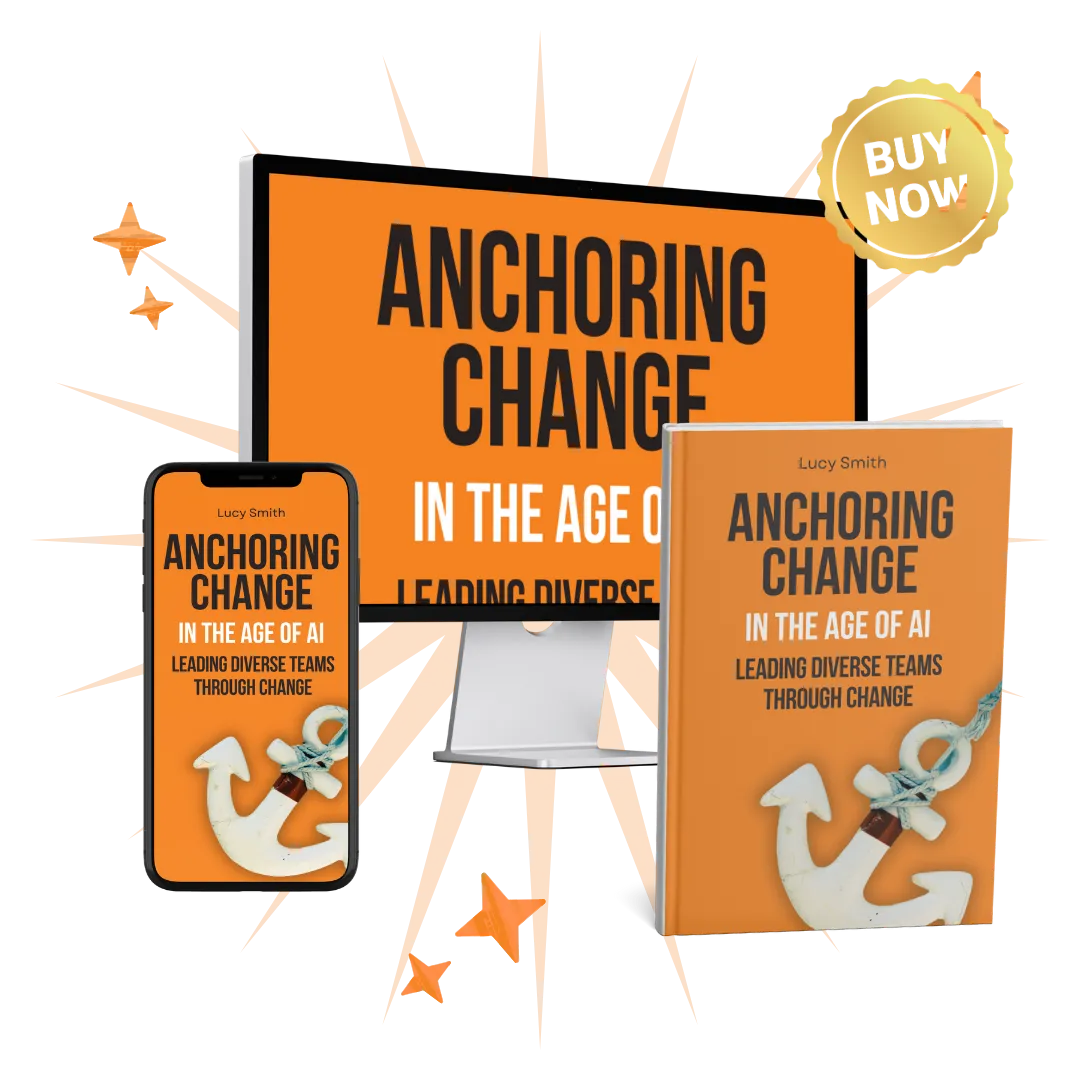
Why technically successful change still fails – and what leaders need to do differently now
AI is accelerating change faster than most organisations are equipped to absorb it.
This book explores what happens between strategy and delivery – where people make sense of change, carry risk, absorb pressure, and quietly adapt long before success or failure is visible on a dashboard.
Anchoring Change in the Age of AI is not about tools, vendors, or implementation frameworks.
It is about the human mechanics of change in environments shaped by automation, data, and constant transition.
For leaders who want change that actually holds.
What is this book about?
Most AI and digital transformation programmes fail for reasons that are rarely named.
Not because the technology didn’t work.
Not because people “resisted”.
But because the organisation underestimated how meaning, responsibility, and judgement shift when systems change.
This book examines:
How assumptions travel through programmes
How pressure accumulates in roles without authority
How sense-making happens unevenly and often privately
How AI amplifies existing cracks in leadership, trust, and decision-making
Told through a short business fable and grounded analysis, the book makes visible the work organisations rely on from teams to navigate change.
Who is this book for?
This book is written for people who are involved in organisational change:
Senior leaders and executive teams
Change managers and transformation leads
Programme and project managers
HR, People, and OD professionals
Consultants working in AI, digital, or operational change
Policy, public sector, and regulated environments
If you’ve ever thought:
“We’ve done everything right on paper… so why does this feel so fragile?”
This book is for you.
Hi, I am Lucy,
Author of Anchoring Change in the Age of AI

I’m Lucy Smith, the founder of Inclusive Change, a UK-based consultancy I established in 2020 with a clear purpose: to help organisations build the future of work with neurodiversity and human sustainability in mind.
I’ve spent over 25 years designing courses, curricula, and large-scale programmes across public and private sectors.
Since 2020, I’ve built and led multiple organisations, including a neurodivergent support agency and a social enterprise focused on inclusive employment and digital skills. Alongside consultancy work, I support leaders to design systems, processes, and ways of working that reduce cognitive load, clarify decision-making, and protect people during sustained change.
My approach to change is grounded and human. I don’t frame difficulty as resistance or individual failure. Instead, I help organisations see how structure, pace, and leadership choices distribute risk – and how those patterns are intensified in AI-enabled environments.
I live and work in the UK, balancing consultancy, writing, and social impact work. I’m known for asking the questions that challenge formal change programmes – usually with warmth, clarity, and the occasional dry sense of humour.
I know you have questions...
So here are some answers, and if we don't have an answer you need here - get in touch
What is this book about?
This book explores why organisational change often fails even when the strategy is sound and the technology works.
It focuses on the human mechanics of change – how people make sense of uncertainty, where responsibility and risk really sit, and what happens when automation and AI increase pace without increasing clarity.
Rather than offering tools or implementation frameworks, the book examines how leadership decisions, framing, and structure shape whether change holds or quietly fractures over time.
Is this book about Artificial Intelligence?
Not in the way most AI books are. AI is the context, not the centre. The book is about change, leadership, and responsibility in environments shaped by automation, data, and constant transition. You don’t need technical knowledge of AI to read it. If you are involved in leading, sponsoring, or delivering change in an AI-influenced organisation, the book will feel familiar.
Who is this book for?
This book is written for people who sit close to the consequences of change, including:
Senior leaders and executive teams
Change, transformation, and programme leads
Project and delivery managers
HR, People, and OD professionals
Consultants working in digital, AI, or operational change
Leaders in regulated, public sector, or complex environments
If you’ve ever felt that a change programme looked fine on paper but felt fragile in practice, this book is for you.
What can I expect from this book?
You can expect:
A short business fable that reflects real organisational life
Clear explanations of why certain change patterns repeat
Language you can use with leadership teams
Insight into pressure, accountability, and sensemaking during change
A reframing of “resistance” as a system issue, not a people problem
You won’t find hype, buzzwords, or simplistic answers. The book is designed to help you see what’s really happening, not to sell a solution.
Is this a reflective or practical book?
Both.
The book itself is reflective and analytical, designed to shift how you see change. Alongside it is an optional companion guide that offers chapter summaries, leadership reflections, and discussion prompts suitable for teams, workshops, or coaching.
Together, they support both thinking and action – without turning complex issues into checklists.
Do I need to be a senior leader to read this book?
No.
While the book is written with senior decision-makers in mind, many readers in change, project, and people roles recognise their lived experience in the story.
In fact, it often resonates strongly with those who carry responsibility without authority – and helps explain why that role can feel so heavy during transformation.
How is it different from other Change Management books?
Most change books focus on what leaders should do.
This book focuses on what people are actually carrying during change – especially when systems become more automated and decisions are increasingly abstracted.
It doesn’t ask people to be more resilient.
It asks organisations to be more honest about how they design change.
Can this be used with leadership teams or in organisations?
Yes.
The book and companion guide are designed to be used in:
leadership team discussions
programme reset points
executive away days
facilitated workshops
coaching and advisory work
Many organisations use it as a shared language for conversations that are often avoided or hard to frame.
Is this book neurodiversity focussed?
Neurodiversity is part of the lens, but not the headline.
The book recognises that change impacts people differently, and that systems often privilege certain thinking and coping styles. Rather than separating neurodiversity as a “special case”, it treats inclusive design as good leadership and risk management for everyone.
What’s the key message of the book?
Change doesn’t fail because people are difficult. It fails when meaning, responsibility, and risk are poorly anchored.
In the age of AI, that anchoring matters more than ever.
Some of the Companies We Have Worked With


Find out more about our services for organisations
Inclusive Change Ltd
The Brightwell, Bradbury House
Wheatfield Drive
Bradley Stoke, Bristol
BS329DB
Reg no: 12412464
Copyright 2025 Inclusive Change Ltd
VAT NO: 352 1564 17
ICO Reg: ZB081779
UK Register of Learning Providers: 10090652
COPYRIGHT © 2025 INCLUSIVE CHANge LTD. ALL RIGHTS RESERVED.