
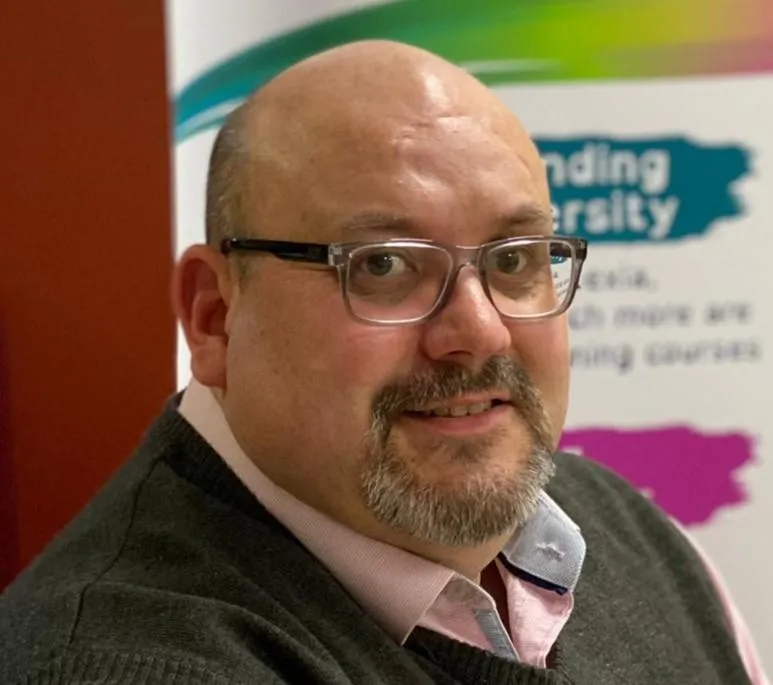
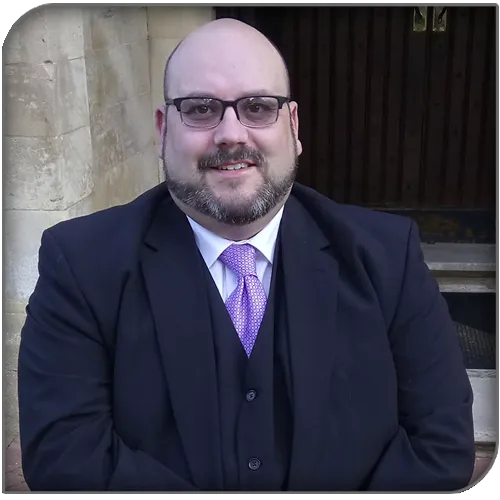
Daniel Biddle
Motivational Speaker, Disability Law Expert
Empowering Neurodiversity in the workplace
Daniel Biddle
Daniel is a highly experienced accessibility consultant with extensive experience of disability. Daniel has particular expertise in acquired disability, including acquired neurodiversity.
He established the National Disability Employment & Advisory Service in 2022 and focuses on supporting neurodivergent young people & adults into employment.
Work with me
Ready to transform your understanding of disability law and equity in the workplace?
Would you like me to run a workshop for you? Contact me through Inclusive Change using the calendar below.
Read my blog here
Read more
The blog
The Future of Work Isn’t About AI. It’s About How We Lead People Through Constant Change
The Future of Work Isn’t About AI.
It’s About How We Lead Through Change
AI has moved from the edges of organisational life to the centre with remarkable speed. New tools promise efficiency, insight and scale. Boards ask about adoption. Leaders ask about productivity. Teams are told to “lean in” and staff are using AI for all sorts of things (let's leave that for another time).
Yet beneath all the noise, a quieter truth is emerging.
Change is no longer discreet. It is structural.
For decades, organisational change followed a familiar pattern. A period of stability, followed by a change programme, then a return to "business as usual" or usually the "new normal" where you expected to stay for a while.
Right now, I would say that cycle no longer exists.
AI has not simply introduced new technology. It has fundamentally altered the pace, frequency and visibility of change at work. Systems update weekly. Roles shift quietly. Decisions are made faster, often with less explanation or context. Many organisations now operate in a permanent state of transition. Now, don't think this is only about AI, it is most certainly not, it's a result of so many other factors - on a personal note I remember well the early days of the Covid pandemic in March/April 2020 when I had just started Inclusive Change, it felt like every day brought with it new rules, new environment, new context and we were operating in a constant state of change and in 2026 I can see more of this but the biggest driver of this is going to be AI.
In practical terms, this means the future of work is defined less by innovation events and more by ongoing adaptation.
Most leadership models, management processes and people systems were never designed for this level of sustained cognitive and emotional load so we are going to have to adapt.
The real challenge is not adoption, but adaptation
Much of the current conversation focuses on whether organisations are adopting AI quickly enough. In reality, the more important question is whether they are adapting well.
Adaptation is not about tools or platforms. It is about how work is experienced by people.
It shows up in:
How decisions are made under uncertainty
How clear people are about expectations as roles evolve
Whether trust is maintained when processes shift
How leaders respond when people struggle, resist or disengage
When these conditions are absent, AI does not solve organisational problems. It accelerates them.
This is why so many AI-led change initiatives fail: not because the technology is wrong, but because the human system cannot absorb the pace of change.
People are already signalling the strain
Across sectors, early indicators are becoming harder to ignore:
Managers overwhelmed by decision volume
High performers quietly burning out
Teams disengaging from yet another “transformation”
Neurodivergent staff experiencing heightened stress, confusion or exclusion
These experiences are often framed as individual resilience issues.
Let me be clear... They are not.
They are system signals.
When people struggle to keep up with change, it is rarely because they are incapable. More often, it is because the environment demands constant adjustment without sufficient clarity, support or psychological safety.
This is particularly visible for neurodivergent employees, who often experience the impact of poorly designed change earlier and more intensely. In this sense, neurodiversity is not a side issue in the future of work. It is an early warning system.
Leadership capability matters more than technology strategy.
AI strategy has become a standard board agenda item. Leadership capability for constant change has not.
Yet leadership is the determining factor in whether AI-driven change becomes sustainable or corrosive.
Leadership in the future of work requires different skills and mindsets:
Sense-making rather than certainty
Transparency rather than reassurance
Designing change around human capacity, not just operational efficiency
Recognising that inclusion and performance are increasingly inseparable
This is not about slowing innovation. It is about ensuring organisations remain functional, ethical and human as they evolve.
When leadership capability does not keep pace with change, the cost is paid in burnout, disengagement and loss of trust.
Why we’re starting this conversation now.
Future of Work with Inclusive Change exists to examine the intersection that I think many organisations are currently missing: AI, leadership, change and human impact.
Over the coming weeks, I will explore:
How AI-driven change actually shows up inside organisations
What happens when change is poorly led, and why it is so costly
Why neurodiversity offers insight into the future of work rather than sitting at its margins
What adaptive, human-centred organisations do differently
The future of work is not a distant concept. It is being built now, often quietly and a bit uneven.
The question is not whether change will continue.
It is whether organisations will learn to lead it well.

Join the conversation: AI, Change & Neurodiversity
If this resonates and you are navigating AI-driven change in your organisation, we are opening this conversation in a live webinar in January.
14 January 2026: Start the Conversation: AI, Change & Neurodiversity
This webinar is for HR, L&D and senior leaders who want to move beyond hype and explore:
What constant change is doing to people
Why neurodiversity matters in AI-driven environments
How leadership capability needs to evolve
It is not a tech demo.
It is a space for reflection, sense-making and more human leadership.
https://inclusivechange.co.uk/stc-ai-change-and-neurodiversity
Frequently Asked Questions
Is the future of work really about AI?
No. The future of work is shaped less by AI itself and more by how leaders guide people through constant, accelerating change. AI increases speed and complexity, but leadership determines whether people can adapt sustainably or burn out under pressure.
AI is not a single transformation event. It is an ongoing force that reshapes how decisions are made, how work is experienced and how quickly expectations shift. When organisations focus only on tools and adoption timelines, they miss the deeper issue: human capacity.
What does “continuous change” mean in the workplace?
Continuous change means organisations are no longer moving between stability and transformation. Change is now permanent.
AI has accelerated how often systems change, how quickly roles evolve, and how little time people have to adapt. Most leadership models were not designed for this level of cognitive and emotional load.
Why do change initiatives fail during AI adoption?
Most AI-led change fails because organisations focus on technology and underestimate the human impact of rapid change. When clarity, trust and psychological safety are missing, AI accelerates existing problems rather than solving them.
How does AI-driven change affect employees?
AI-driven change increases cognitive load, decision fatigue and uncertainty. We are already seeing burnout, disengagement and stress, particularly among managers, high performers and neurodivergent staff.
Why is neurodiversity important to the future of work?
Neurodiversity often highlights where systems fail under pressure. Designing work that supports neurodivergent people improves clarity, reduces overload and creates more sustainable organisations for everyone.

Column Header
Lorem ipsum dolor sit amet consecetuer lorem ipsum
Organically grow the holistic world view of disruptive innovation
At the end of the day, going forward, a new normal that has evolved
Column Header
Lorem ipsum dolor sit amet consecetuer lorem ipsum
Organically grow the holistic world view of disruptive innovation
At the end of the day, going forward, a new normal that has evolved
Column Header
Lorem ipsum dolor sit amet consecetuer lorem ipsum
Organically grow the holistic world view of disruptive innovation
At the end of the day, going forward, a new normal that has evolved
Some of the Organisations Inclusive Change Have Worked With


Inclusive Change Ltd
The Brightwell, Bradbury House
Wheatfield Drive
Bradley Stoke, Bristol
BS329DB
VAT NO: 352 1564 17
ICO Reg: ZB081779
UK Register of Learning Providers: 10090652
Copyright 2025 - Inclusive Change Ltd