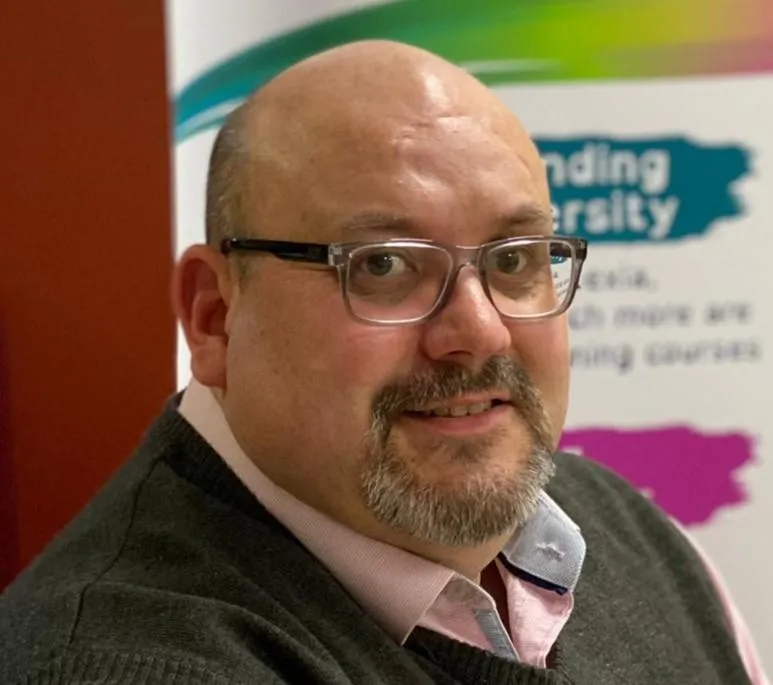
Daniel Biddle
Motivational Speaker, Disability Law Expert
Empowering Neurodiversity in the workplace
Daniel Biddle
Daniel is a highly experienced accessibility consultant with extensive experience of disability. Daniel has particular expertise in acquired disability, including acquired neurodiversity.
He established the National Disability Employment & Advisory Service in 2022 and focuses on supporting neurodivergent young people & adults into employment.

Work with me
Ready to transform your understanding of disability law and equity in the workplace?
Would you like me to run a workshop for you? Contact me through Inclusive Change using the calendar below.
Read my blog here
Read more
The blog
Team Building for People Who Hate Team Building
Team Building for People Who Hate Team Building
I’ll admit it. I’m not the biggest fan of team building. Put me in a room and tell me we’re doing an icebreaker, and there’s a reasonable chance part of my brain is already looking for the nearest exit.
But recently I had an experience that made me think differently about what team building can actually do when it’s designed well. I took part in an crisis simulation; Decision-Making Under Pressure Coaching & Consulting | DecidR UK. Now, on paper, this has quite a few elements I wouldn’t necessarily choose for a fun day! A time limit. Pressure. Lots of information. Accounts of profit and loss. Problems that need solving quickly.
But what was fascinating wasn’t just the content from DecidR the crisis simulation itself. It was what happened to us as a team when the pressure went up.
Pressure changes how we work
Very quickly, you start to notice differences.
One person is focusing to how it happened instead of how to fix it.
Someone wants to stop and work through the information methodically.
Someone else has already come to a conclusion.
One person takes the lead. Another becomes quieter.
Someone is brilliant at seeing the bigger picture while somebody else notices the tiny detail.
And then there's communication. Under pressure, it changes.
People interrupt. Instructions get missed. Assumptions are made. Two people can be working on exactly the same problem without realising it.
Sound familiar?
We don't suddenly become different people at work

Deadlines move.
A system stops working.
A customer complains.
A restructure is announced.
Something unexpected happens and a decision needs to be made quickly.
The pressure increases and suddenly the carefully designed processes and communication structures don't always work quite as neatly as they did on paper.
And people respond differently.
For some people, pressure creates focus. For others, it makes it harder to process information or prioritise what needs to happen first.
Some people naturally take control. Some need a little more time before responding.
Some want more information before making a decision. Others are comfortable acting with what they already know.
Neurodiversity can be part of this, but so can personality, experience, confidence, role, workplace culture and the situation itself.
None of these responses automatically makes someone better or worse at their job.
What matters is whether a team understands how it operates when things aren't going to plan.
The most interesting bit came afterwards
This was where the experience became much more useful than simply having done an crisis simulator (DecidR) together.
We could look back at what had happened.
Who communicated?
Who noticed things?
When did we make good decisions?
Where did we lose time?
What happened to the costs?
What was the impact of our decisions on the business?
What happened when we weren't sure what to do?
But the real value comes from understanding what the experience tells you about how your team works.
What happens when the stakes are higher?
DecidR gives you a safe version of pressure. At work, the consequences can be very different.
Leaders and teams regularly make decisions with incomplete information, competing priorities and limited time. And that's exactly when our usual patterns can become more pronounced.
We can rush.
Overthink.
Follow the most confident voice.
Avoid challenging an assumption.
Keep looking for more information when we already have enough.
Or make a decision without noticing something important.
So perhaps the most useful question isn't simply:
How good is your team at making decisions?
How does your team make decisions when the pressure is on?
From team building to DECID:R
That thinking sits behind DECID:R, which helps leaders and teams understand what happens to their thinking, communication and decision-making when pressure, uncertainty and complexity increase.
Rather than teaching leaders another theoretical decision-making model and hoping they remember it when things get difficult, DECID:R looks at what actually happens when people have to make decisions in complex, pressured situations.
It helps leaders and teams examine how they process information, communicate, challenge assumptions and reach decisions, including the individual differences that can influence each of those things.
The aim isn't to create teams where everyone thinks in the same way.
Quite the opposite.
Different perspectives, thinking styles and experiences can be hugely valuable when organisations are making difficult decisions.
The challenge is creating the conditions where those differences improve the decision rather than getting lost in the pressure surrounding it.
That might mean understanding who needs time to process, recognising when speed is genuinely necessary, noticing whose voice isn't being heard, communicating more clearly or becoming more aware of the patterns that appear when uncertainty increases.
Because better decision-making isn't just about having smart people in the room.
It's about understanding how those people think and work together when it matters.
What would your team discover?
The exercise reminded me that sometimes you learn far more about a team by watching what happens when the plan disappears.
Who steps forward?
Who spots what everybody else missed?
Who asks the question that changes the direction?
Who goes quiet?
And what happens to the quality of your decisions when the clock starts ticking?
Those are conversations worth having.
And they're considerably more useful than another awkward icebreaker.
If you'd like to explore how you or your team make decisions under pressure, take a look at our DECID:R Decision-Making Under Pressure Coaching & Consulting.
We work with individuals, leaders and teams to understand decision-making patterns and develop practical approaches for clearer, more confident decisions when the pressure is on. DECID:R turns that learning into an engaging, realistic experience. Teams are put into situations where they need to think, communicate and make decisions together, giving them the opportunity to see their real behaviours and decision-making patterns emerge. It’s more than a generic icebreaker or team-building exercise – it creates meaningful conversations about what happens when the pressure increases and, importantly, what teams can do differently back in the workplace.

Column Header
Lorem ipsum dolor sit amet consecetuer lorem ipsum
Organically grow the holistic world view of disruptive innovation
At the end of the day, going forward, a new normal that has evolved
Column Header
Lorem ipsum dolor sit amet consecetuer lorem ipsum
Organically grow the holistic world view of disruptive innovation
At the end of the day, going forward, a new normal that has evolved
Column Header
Lorem ipsum dolor sit amet consecetuer lorem ipsum
Organically grow the holistic world view of disruptive innovation
At the end of the day, going forward, a new normal that has evolved
Some of the Organisations Inclusive Change Have Worked With


Inclusive Change Ltd
The Brightwell, Bradbury House
Wheatfield Drive
Bradley Stoke, Bristol
BS329DB
VAT NO: 352 1564 17
ICO Reg: ZB081779
UK Register of Learning Providers: 10090652
Copyright 2025 - Inclusive Change Ltd