

Daniel Biddle
Motivational Speaker, Disability Law Expert
Empowering Neurodiversity in the workplace
Daniel Biddle
Daniel is a highly experienced accessibility consultant with extensive experience of disability. Daniel has particular expertise in acquired disability, including acquired neurodiversity.
He established the National Disability Employment & Advisory Service in 2022 and focuses on supporting neurodivergent young people & adults into employment.

Work with me
Ready to transform your understanding of disability law and equity in the workplace?
Would you like me to run a workshop for you? Contact me through Inclusive Change using the calendar below.
Read my blog here
Read more
The blog
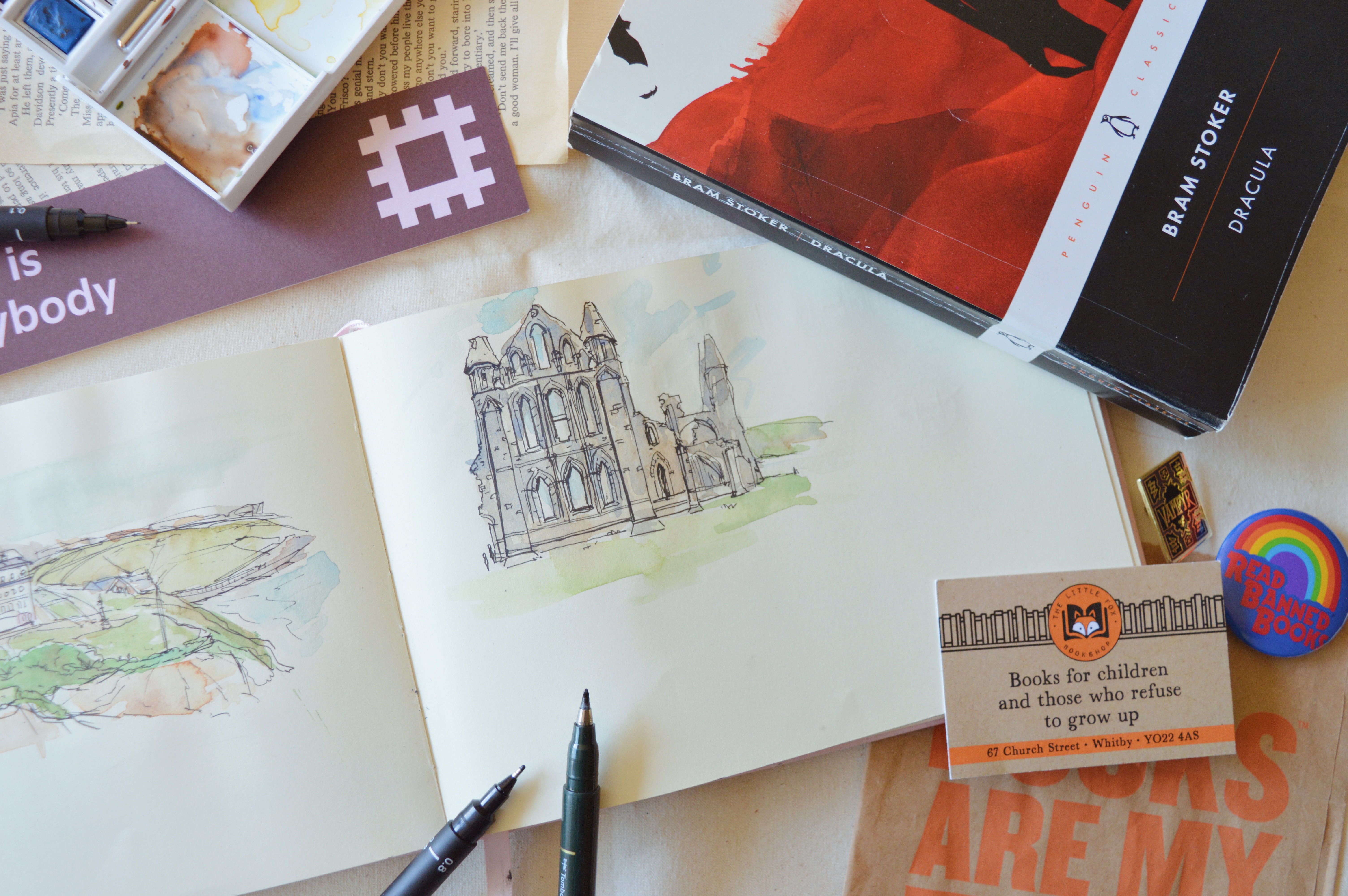
Walking in Bram Stoker's Footsteps || A Bookish Day in Whitby
Last week I had the pleasure of spending a day in Whitby.
Bram Stoker himself famously visited this quiet seaside town in 1890, finding much inspiration for his upcoming gothic novel there - including the name for the Count himself, which he reportedly found when browsing the local library.
Dracula is my favourite book of all time, and this has been a huge bucket-list item for me since first reading it at 15. So, whilst planning a visit to York, I made sure to squeeze in a detour to the little seaside town.
After many re-reads of Stoker’s best-known novel, I felt as if I had somehow become rather well acquainted with Whitby, but being able to stand within the setting of much of Mina’s earlier journals was entirely surreal - and being able to walk in her footsteps was like something out of a dream.
The Journey
Mina Murray’s Journal
'24 July. Whitby - Lucy met me at the station, looking sweeter and lovelier than ever, and we drove up to the house at Crescent in which they have rooms. This is a lovely place. The little river, the Esk, runs through a deep valley, which broadens out as it comes near the harbour. A great viaduct runs across, with high piers, through which the view seems somehow further away than it really is. The valley is beautifully green, and it is so steep that when you are on the high land on either side you look right across it, unless you are near enough to see down. The houses of the old town--the side away from us, are all red-roofed, and seem piled up one over the other anyhow, like the pictures we see of Nuremberg.'
I like to try to picture what Mina’s journey was like coming into Whitby.
Whilst vastly different to the modern railway experience of today, I imagine many of the views remained similar. Quite a leisurely journey, after two changes in order to reach Middlesbrough, I spent the last leg glued to my window, entranced by the rugged Yorkshire countryside outside. We passed through countless quiet, Hogsmeade-esque train stations, wide-stretching farmland and field upon field of bounding rabbits. It’s wildly wonderful just how much of a difference a few miles North makes in the scenery and architecture of a place.
Despite a long delay, thanks to a rogue wandering cow on the tracks, I made it to Whitby station; and although not greeted by Lucy Westenra, I was met by the same beautiful valleys and red-roofed, river-side houses described above.
Memories of a ghost ship
‘The harbour lies below me, with, on the far side, one long granite wall stretching out into the sea, with a curve outwards at the end of it, in the middle of which is a lighthouse. A heavy seawall runs along outside of it. On the near side, the seawall makes an elbow crooked inversely, and its end too has a lighthouse. Between the two piers there is a narrow opening into the harbour, which then suddenly widens.
It is nice at high water, but when the tide is out it shoals away to nothing, and there is merely the stream of the Esk, running between banks of sand, with rocks here and there. Outside the harbour on this side there rises for about half a mile a great reef, the sharp of which runs straight out from behind the south lighthouse. At the end of it is a buoy with a bell, which swings in bad weather, and sends in a mournful sound on the wind.'
The next morning, I woke up to a gloomy, grey sky and an awkward, almost-not-there drizzling rain.
However, I had planned to get out for an early morning walk along the harbour, and an early morning walk I had - even though I did end up completely soaked.
But honestly, what better weather could you want to experience Bram Stoker’s Whitby?
A fog lay over the sea, accompanied with howling winds and crashing waves, and I swear I could almost see The Demeter, shipwrecked on the bay.
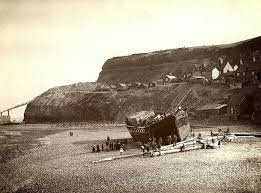
1885, the wreck of The Dmitry upon Tate Hill Sands, Whitby.
Pictured above is the shipwreck that inspired that of The Demeter in Bram Stoker’s novel - the ship that brings Dracula to the sands of England during one fateful storm.
Stoker would have seen this photograph somewhere during his visit, prompting the idea for the Count’s voyage across the sea...
‘all took place more quickly than it takes to write these words. The schooner paused not, but rushing across the harbour, pitched herself on that accumulation of sand and gravel washed by many tides and many storms into the south-east corner of the pier jutting under the East Cliff, known locally as Tate Hill Pier.
There was of course a considerable concussion as the vessel drove up on the sand heap. Every spar, rope, and stay was strained, and some of the ‘top-hammer’ came crashing down. But, strangest of all, the very instant the shore was touched, an immense dog sprang up on deck from below, as if shot up by the concussion, and running forward, jumped from the bow on the sand.'
Dreaming of ghost ships, I strolled up the West Lighthouse and then fought my way through the wind along the precarious wooden pier to the Jetty, a great spot for a full view of the town (although maybe not for those with a fear of heights or open water), and you only need to turn to be met with the sea as far as you can… well, see.
Breakfast and bookshops
After drying off in my hotel, the rain let up and so it was time to head out for some breakfast.
I decided to go to Mr Cooper’s Coffee House, where I snagged a seat in the window to enjoy some people watching along with a heavenly pistachio croissant (my mouth still waters thinking about it), a pot of mint tea and my current read. Seats started to fill up quickly as the sun came out, so if you are wanting to visit for a bite in the morning, I would definitely recommend getting in there early or planning to take-away.
Before embarking on any major sightseeing, I took my morning slow by just exploring the high streets and having some fun with a little bit of window shopping. I found some lovely bookshops, many of which were stocked with shelves of local history, fiction and, of course, countless special-edition copies of Dracula. But my favourite bookshop had nothing to do with Stoker at all.
The Little Fox Bookshop was a small, magical shop for ‘children and those who refuse to grow up,’ filled completely with children’s literature, nature writing, and whimsical woodsy displays. It felt like stepping into a cosy storybook - they even had a wardrobe to Narnia!
Once I had my fill of quirky art, bookshops and glittering displays of Whitby jet, it was time to trek up the 199 steps.
198 Steps Too Many
‘The steps are a great feature of the place. They lead from the town to the church, there are hundreds of them, I do not know how many, and they wind up in a delicate curve. The slope is so gentle that a horse could easily walk up and down them.
I think they must originally have had something to do with the abbey. I shall go home too. Lucy went out, visiting with her mother, and as they were only duty calls, I did not go.’
The word ‘trek’ is actually quite an over exaggeration on my part; in reality the steps themselves were rather shallow… there’s just a lot of them!
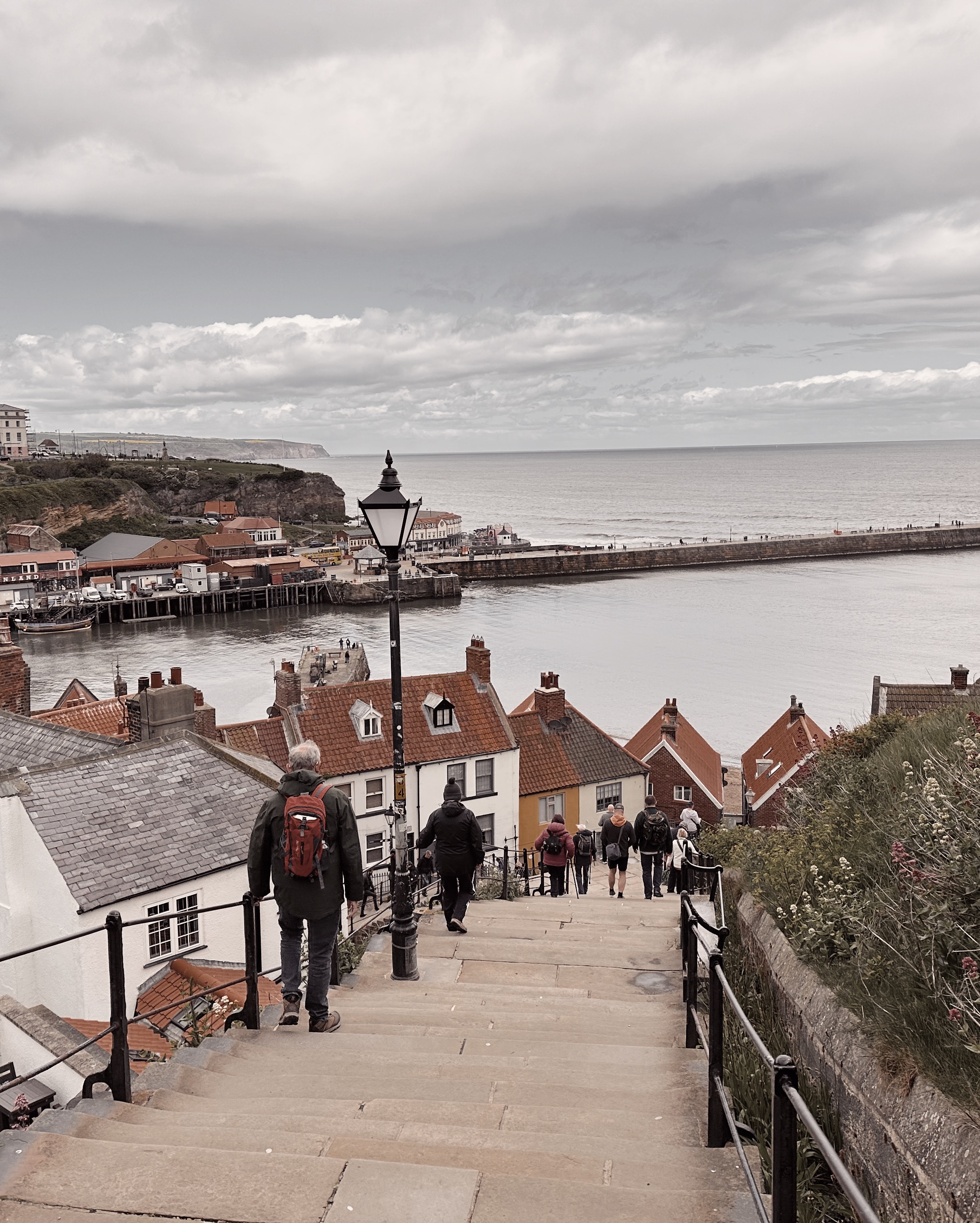
The view from the steps
Halfway up, as the worn path curves, I’d recommend pausing for a breather, so you can turn around and revel in the patchwork of houses that unfolds before you into lighthouse-topped piers framing the mouth of the Esk.
You could even take a seat on one of the few coffin-rests-turned-benches placed along the steps… just watch out for any wild, black dogs scrambling up beside you, especially if you happen to be out on a stormy night!
At the top of the stairs sits St Mary’s Church and graveyard: an originally Norman church building overlooking the town, surrounded by time-worn graves that jut out of the dirt like crooked teeth.
Grave Inspiration
‘Between it and the town there is another church, the parish one, round which is a big graveyard, all full of tombstones. This is to my mind the nicest spot in Whitby, for it lies right over the town, and has a full view of the harbour and all up the bay to where the headland called Kettleness stretches out into the sea. It descends so steeply over the harbour that part of the bank has fallen away, and some of the graves have been destroyed.
In one place part of the stonework of the graves stretches out over the sandy pathway far below. There are walks, with seats beside them, through the churchyard, and people go and sit there all day long looking at the beautiful view and enjoying the breeze.
I shall come and sit here often myself and work. Indeed, I am writing now, with my book on my knee, and listening to the talk of three old men who are sitting beside me. They seem to do nothing all day but sit here and talk.’
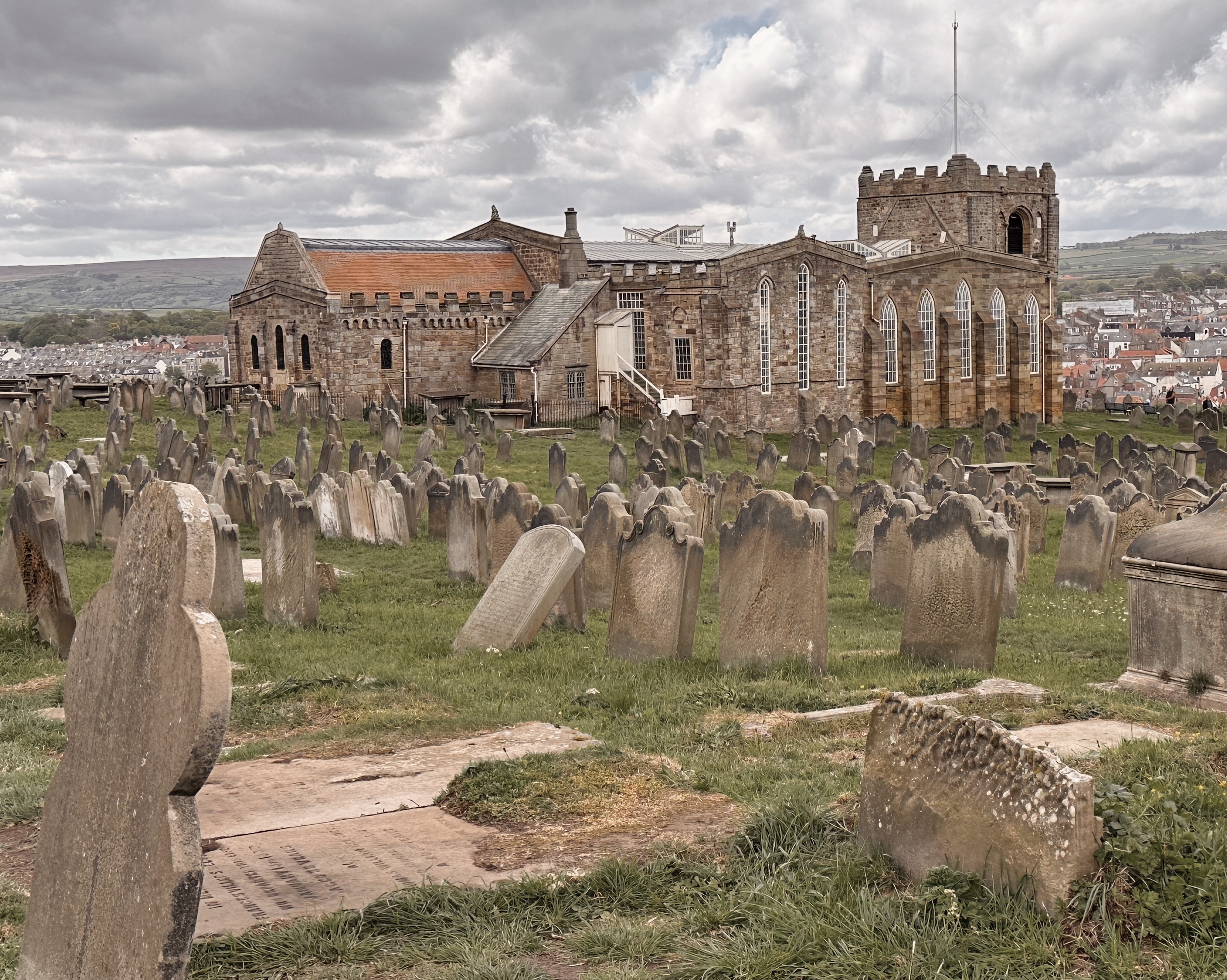
St Mary’s Churchyard and it’s many graves
Several of the tombstones in this churchyard have become so battered by the weather that they are rendered illegible and many of the graves were erected in memory of those lost at sea, without a body to bury; two are even marked with skull-and-crossbones (although it’s hard to tell who these graves belonged to… arguments have been made for freemasons, members of the knight’s templar, victims of French privateers, the Count Dracula or just someone completely ordinary).
Stoker himself gained inspiration for character names on walks through this same cemetery, finding the names of Swales and Storr scattered amongst the teetering tombstones.
With such a beautiful view of the town, I decided to perch on a perfectly-placed bench, a spot Mina was likely familiar with as I paused for some sketching.
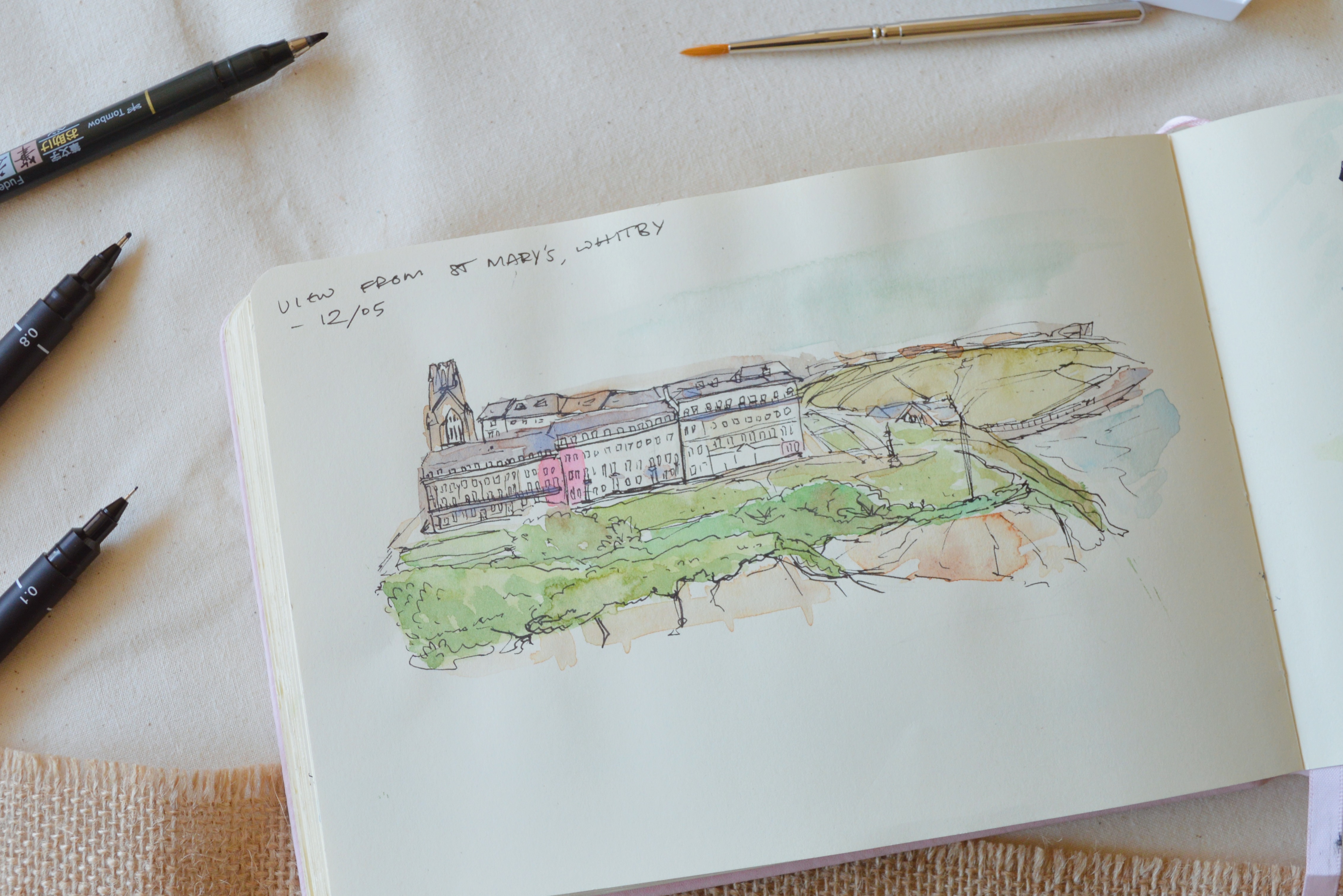
A little peak at my sketchbook from this day
Poets, ghosts, and tragic affairs
Then, to the star of the show… the famous Whitby Abbey.
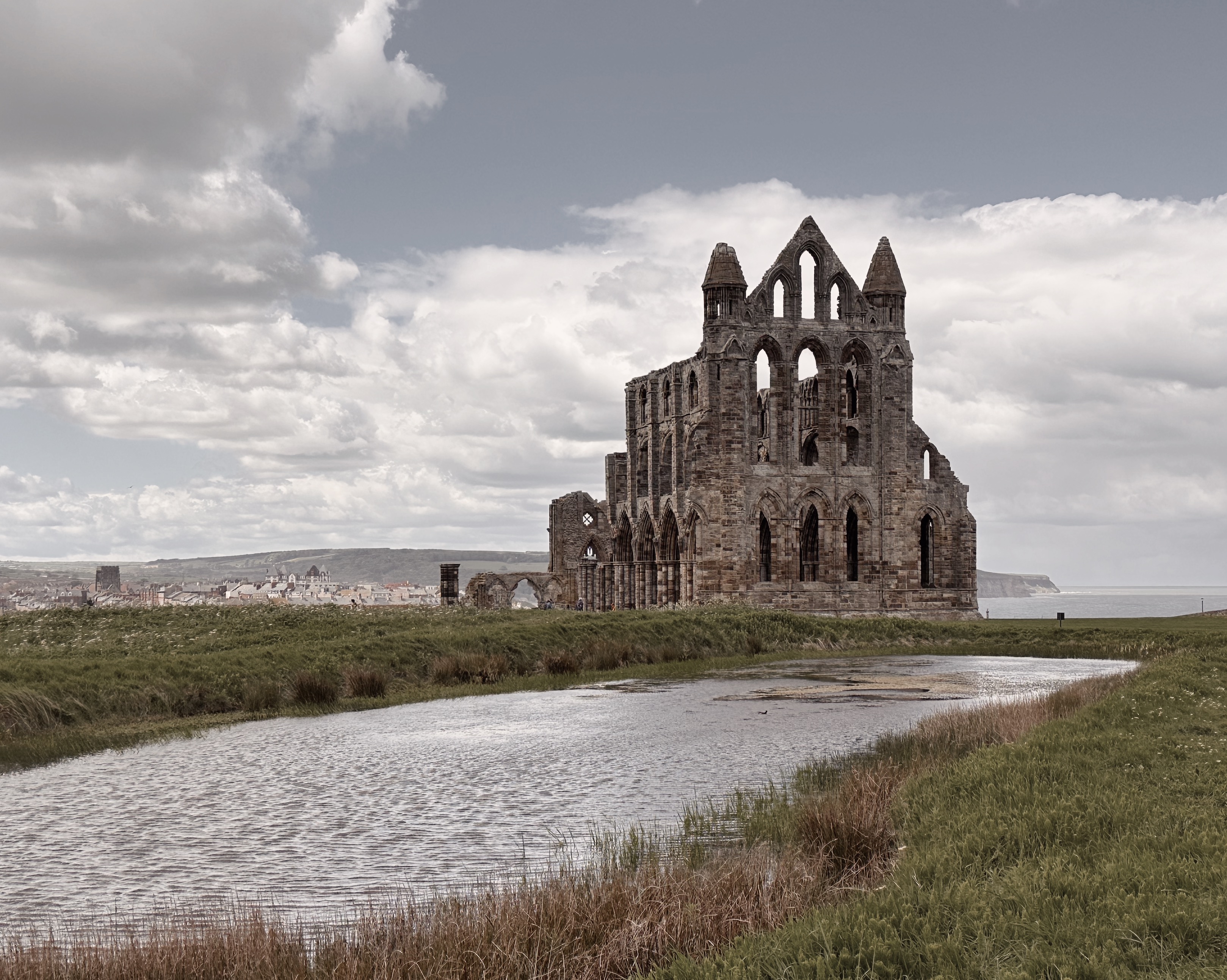
'Right over the town is the ruin of Whitby Abbey, which was sacked by the Danes, and which is the scene of part of "Marmion," where the girl was built up in the wall. It is a most noble ruin, of immense size, and full of beautiful and romantic bits. There is a legend that a white lady is seen in one of the windows.'
Home to millennia of history and folklore, the Abbey has been a magnet for pilgrims, poets and artists alike for centuries. As many of you will be aware, Stoker set part of Dracula here, but did you know the site also inspired Cædmon, the first named English poet? He had both an artistic and spiritual awakening whilst living at the Abbey in and around the 680s, leading to a sudden onset penchant for singing and creating divine verses. Although much of what remains of his poetry has been fragmented by time, Bede kindly included one of Cædmon’s hymns in his Ecclesiastical History of the English People:
‘Raise we the fashioner now of Heaven’s fabric,
The majesty of his might and his mind’s wisdom,
Work of the world-warden, worker of all wonders,
How he the Lord of Glory everlasting
Wrought first for the race of men Heaven as a roof-tree,
Then made he Middle Earth to be their mansion.’
(translated into modern english)
Thank you, Bede.
Another story quite literally built within the ruined walls of the Abbey, is actually referenced in Mina’s account above. The tale of Constance de Beverley, a young nun who couldn’t help falling head-over-heals with a knight, leading to a broken vow of chastity. Unfortunately for her, her joy was short-lived as her affair was promptly discovered and she was punished by her sisters who felt it only just to brick her alive within the walls of the Abbey. Constance inspired Sir Walter Scott, who included her fate in his 1808 poem, Marmion, a piece Mina was clearly familiar with.
Despite how heart-breakingly tragic this legend is, the Abbey housed monks, not nuns, so I personally doubt the infamous grey lady truly haunts the windows of Whitby… but you’d better keep your eyes and ears (be warned, she’s a screamer) alert, nevertheless!
The romantic ruins also made a nice spot for sketching despite my freezing hands, and after becoming too cold to hold my pen, I continued into the little museum on-site; filled with far too much local history for me to include in this humble travel blog.
By this point in the afternoon I was exhausted, so I took a break in my room at The Resolution Hotel for a while to decompress. Fortunately, Whitby is a fairly small town, so it didn’t take me long to walk back.
Being autistic, I feel as though I’m constantly over-processing the world around me, so my energy drains faster than most and it’s easy to become so overwhelmed that my brain feels like it’s practically shutting down. As a result, it’s more important to take frequent breaks, especially when travelling, in order to make the most of my day. An hour or two of total rest in the afternoon, within the safety of my hotel room can make or break a trip.
I closed my evening with another beach-side walk (although with much better weather) and dinner; then I found a seat at the Whalebone Arch, armed with my noise-cancelling headphones and some good music whilst I watched the sun set over the valley.
If any of you are similar, don’t feel guilty about needing a rest when travelling… you don’t need to be constantly sightseeing. In fact, the soft, slow spaces in between attractions are often some of the best.
Despite delays and initially uncooperative weather, I enjoyed a lovely day in Whitby filled with windy beach-walks and Bram Stoker-inspired sightseeing.
The place is a dream for lovers of history and literature, and I would highly recommend visiting for a few days if you are ever close-by, just be careful if you have a habit of sleepwalking.
I followed up my day in Whitby with another two in York, because when you are taking a 6+ hour train journey somewhere, you ought to make the most of it! There was even more history (and magic) for me to sink my nerdy teeth into, the details of which I’ll share in a later blog post.
For now, thank you so much for reading my mad ramblings here. I hope I have convinced at least one of you to get up to Whitby someday.
Yours sincerely,
Owen @ ScribbleWhiskers
‘Jesus said to her, "I am the resurrection and the life. Whoever believes in Me, though he die, yet shall he live, and everyone who believes in Me shall never die. Do you believe this?”'
John 11:25-26 (ESV)

Column Header
Lorem ipsum dolor sit amet consecetuer lorem ipsum
Organically grow the holistic world view of disruptive innovation
At the end of the day, going forward, a new normal that has evolved
Column Header
Lorem ipsum dolor sit amet consecetuer lorem ipsum
Organically grow the holistic world view of disruptive innovation
At the end of the day, going forward, a new normal that has evolved
Column Header
Lorem ipsum dolor sit amet consecetuer lorem ipsum
Organically grow the holistic world view of disruptive innovation
At the end of the day, going forward, a new normal that has evolved
Some of the Organisations Inclusive Change Have Worked With


Inclusive Change Ltd
The Brightwell, Bradbury House
Wheatfield Drive
Bradley Stoke, Bristol
BS329DB
VAT NO: 352 1564 17
ICO Reg: ZB081779
UK Register of Learning Providers: 10090652
Copyright 2025 - Inclusive Change Ltd