“They’re rude and they’re upsetting the team. What are we supposed to do?”
“They’re rude and they’re upsetting the team. What are we supposed to do?”
The questions managers ask me about neurodiversity – Part 5
This is probably one of the most difficult questions I get asked in neurodiversity training because there can be a very real impact on other people.
A manager tells me they have an autistic or ADHD employee who is very blunt. They interrupt people, say things other colleagues perceive as rude, challenge decisions very directly or don’t seem to recognise when they’ve upset somebody. Sometimes the language becomes stronger: “The rest of the team can’t work with them.” “People are frightened to say anything.” “Everyone is walking on eggshells.”
Then comes the difficult part. The manager knows that communication differences can be associated with neurodivergence. They don’t want to discriminate or penalise someone for being autistic or ADHD, but they also have a team telling them that someone’s behaviour is affecting them.
So what are they supposed to do?
I think we need to be careful of two extremes here. Telling the rest of the team, “They’re autistic, that’s just how they communicate, don’t take it personally” isn’t a good enough response. But neither is expecting a neurodivergent employee to automatically understand and conform to every unwritten social rule in the workplace.
There is a much better conversation to be had in the middle.
Start by getting rid of the word “rude”
If a manager tells me someone is rude, one of my first questions is: “What are they actually doing?”
“Rude” is an interpretation. I need the behaviour.
Perhaps they don’t say good morning when they arrive. Maybe they don’t make eye contact. They give very short answers to questions. They correct colleagues when they’re wrong. They interrupt people. They tell someone, “That won’t work,” without adding the social cushioning that other people might expect.
Or perhaps they’re shouting at colleagues, calling people incompetent, making personal comments or humiliating somebody in front of customers.
Those things aren’t the same.
If we put all of them into a bucket labelled “rude”, we lose the opportunity to understand what is actually happening and what needs to change.
This is particularly important when we’re working with neurodivergent people because many of our workplace expectations around communication aren’t as explicit as we think they are. We expect people to understand tone, hierarchy, facial expressions, when to speak, how much disagreement is acceptable and how to soften what they’re saying. Often nobody has ever actually explained those rules.
Most people learn them through observation and social experience. Some neurodivergent people may not pick up those implicit expectations in the same way.
That doesn’t mean expectations around respectful behaviour disappear. It means we may need to make them much clearer.
Direct isn’t necessarily disrespectful
This is where I think teams sometimes need to do some work too.
Imagine someone says in a meeting:
“I don’t think that will work. We tried it last year and it failed.”
One colleague hears useful directness. Another hears negativity. Somebody else hears challenge. Another person thinks the speaker should have said, “That’s a really interesting idea. I wonder whether we might need to consider what happened when we tried something similar last year?”
Both versions communicate broadly the same information, but one contains considerably more social cushioning.
We need to be careful about deciding that somebody is behaving badly simply because they don’t use the communication style we are accustomed to.
The same applies to eye contact, small talk, facial expression, tone and participation in workplace social activities. Someone who doesn’t ask what you did at the weekend isn’t necessarily unfriendly. A colleague who sends a message saying “I need that report by 3pm” rather than “Hi! Hope you’re having a lovely day. Would you mind possibly sending me the report when you get a chance?” isn’t necessarily angry.
Sometimes inclusion means the rest of us becoming a little less confident in our interpretation of somebody else’s intentions.
But impact still matters
This is the bit I don’t want us to lose.
Intent matters, but so does impact.
If somebody repeatedly says things that upset colleagues, we can’t simply explain every incident away by saying they didn’t mean it that way. The fact that communication differences may be related to neurodivergence helps us understand what is happening and how we might support change. It doesn’t mean other employees are required to accept behaviour that is genuinely harmful.
Suppose an employee says to a colleague in front of a customer, “That’s ridiculous. You clearly don’t know what you’re doing.”
Perhaps the person genuinely intended to communicate, “I disagree with that approach and think there’s a better one.” Understanding that intention is useful, but their colleague may still have experienced the comment as humiliating.
A manager needs to be able to hold both of those things at once.
The conversation might sound something like: “Yesterday, when Sam suggested changing the table plan, you said, ‘That’s ridiculous. You don’t know what you’re doing,’ in front of a customer. I understand you may have been trying to say that you disagreed with the suggestion rather than intending to upset Sam. We do need people in this team to be able to disagree with each other respectfully, so let’s talk about another way you could communicate that.”
That’s much more useful than saying:
“You need to stop being rude.”
If somebody genuinely doesn’t understand which part of their communication is causing the problem, “stop being rude” gives them almost no information they can use.
Make the invisible expectation visible
This is one of the biggest lessons I’ve taken from working with neurodivergent employees.
Managers often believe they’ve been clear when what they’ve actually done is communicate an expectation that relies heavily on social interpretation.
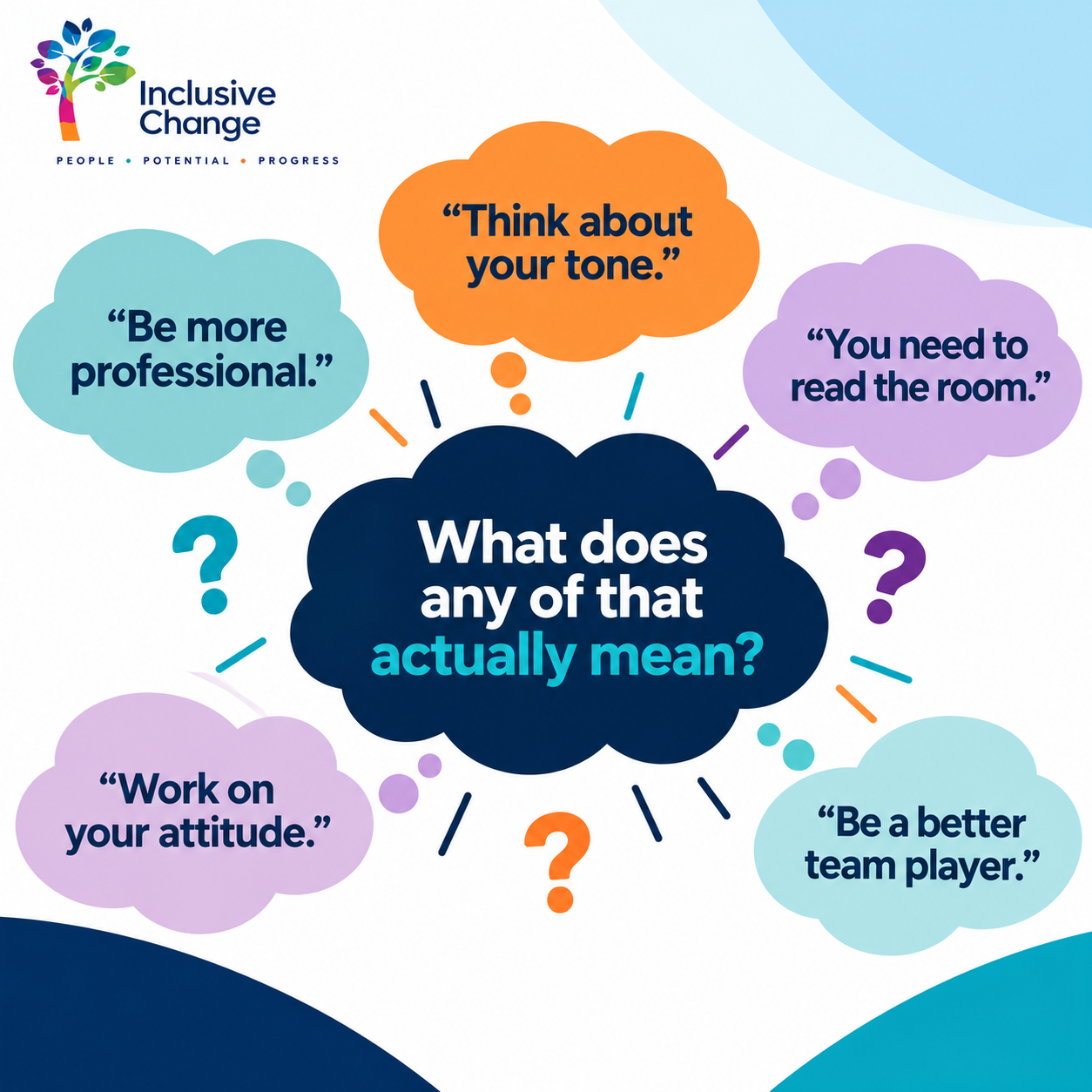
If the behaviour we want to change is interrupting, say that. If the problem is correcting colleagues in front of customers, say that. If people need to be able to disagree without making comments about another person’s intelligence or competence, make that expectation explicit.
Then talk about what the person can do.
“You can absolutely tell me when you think I’ve made the wrong decision. I need you to explain why you disagree rather than saying the decision is stupid.”
“You can tell a colleague that something is incorrect. If a customer is present, unless there’s an immediate safety issue, I want you to speak to them privately afterwards.”
“You don’t have to join in with the team’s social conversations, but we do need everyone to acknowledge colleagues when they need something work-related.”
Those are expectations somebody can understand.
And interestingly, clearer behavioural expectations often help everybody, not just neurodivergent employees.
The team may need to adjust too
This can’t all be about teaching the neurodivergent employee to communicate in a more neurotypical way.
If someone communicates directly, there may be reasonable adaptations colleagues can make too. Perhaps they learn not to automatically interpret a short message as anger. Maybe they ask what someone meant rather than assuming intention from tone. Perhaps they understand that lack of eye contact isn’t disrespect, or that somebody who doesn’t join the lunchtime conversation isn’t rejecting the team.
There is an important difference between asking colleagues to develop a broader understanding of communication differences and telling them they aren’t allowed to be upset by anything a neurodivergent colleague does.
I wouldn’t want to do the latter.
If somebody says, “I’m finding the way Alex speaks to me really difficult,” I want to understand that experience too. What is actually happening? How often? What is being said? What is the impact? Have expectations been made clear? Is there a pattern? Is there something happening when the employee is overwhelmed that we need to understand?
Once again, we’re moving away from labels and towards what is actually happening.
What if the behaviour continues?
This is where managers can become particularly nervous.
What if you’ve explained the expectation, provided specific examples, explored whether neurodivergence is creating a barrier, considered appropriate adjustments, offered support and given the employee an opportunity to change – but the behaviour continues?
Neurodivergence doesn’t mean managers can never address conduct or performance.
The Equality Act 2010 may require reasonable adjustments where a disabled employee is placed at a substantial disadvantage, and employers need to consider whether disability is relevant to the situation. UK Government guidance on reasonable adjustments for disabled workers Acas also recommends that employers consider support and reasonable adjustments when dealing with performance or conduct issues involving disabled employees. Acas guidance on disability at work
That doesn’t mean colleagues have to accept unlimited harmful behaviour because someone is disabled.
What matters is that we don’t punish someone for failing to comply with an invisible social expectation they haven’t understood, particularly where their disability may make that expectation harder to infer. We need to make expectations explicit, explore barriers, consider support and give someone a fair opportunity to meet the required standard.
If, after that, there is still a conduct or performance problem, managers may need to manage it.
That’s not abandoning inclusion. Done properly, it’s part of management.
“We can’t work with them”
When I hear a team say “We can’t work with them,” I want to slow things down before we decide what that means.
Sometimes underneath that statement is genuine distress and behaviour that needs addressing. Sometimes there is a breakdown in trust that will require careful work to repair. But sometimes what we’re seeing is a team that has developed a shared interpretation of somebody as “difficult”, and almost everything that person subsequently does is viewed through that lens.
Once somebody has become the difficult person, it can be incredibly hard for them to escape that label.
That’s why managers need specifics.
What happened? What was said? When? What was the impact? What expectation wasn’t met? Does the employee understand that expectation? Is there a disability-related barrier? What support might help? What does the employee say happened?
Those questions give everybody a much better chance of being heard than simply deciding who is right.
Perhaps we need to talk less about “rudeness”
So when a manager tells me, “They’re rude and they’re upsetting the team,” I’m not going to tell them to ignore it because the person is neurodivergent. I’m also not going to assume that the team’s interpretation of someone’s communication is automatically correct.
I’m going to ask what is actually happening.
Then we can separate communication difference from genuinely unacceptable behaviour, understand the impact on colleagues, make expectations explicit and explore whether there are barriers or adjustments that need addressing.
The neurodivergent employee may need to change some things. The team may need to understand some things differently. The manager may need to communicate much more clearly. Quite often, all three will be true at the same time.
And perhaps that’s the important point.
Inclusive communication isn’t about deciding whose communication style is right. It’s about creating enough shared understanding that people can work together respectfully.
This is the fifth article in my series, The questions managers ask me about neurodiversity, where I’m exploring the difficult questions I hear in real workplaces and training rooms. These aren’t questions I want managers to be frightened to ask. They’re questions I think we need to get much better at answering.
Next: “What if a reasonable adjustment sounds unreasonable?”