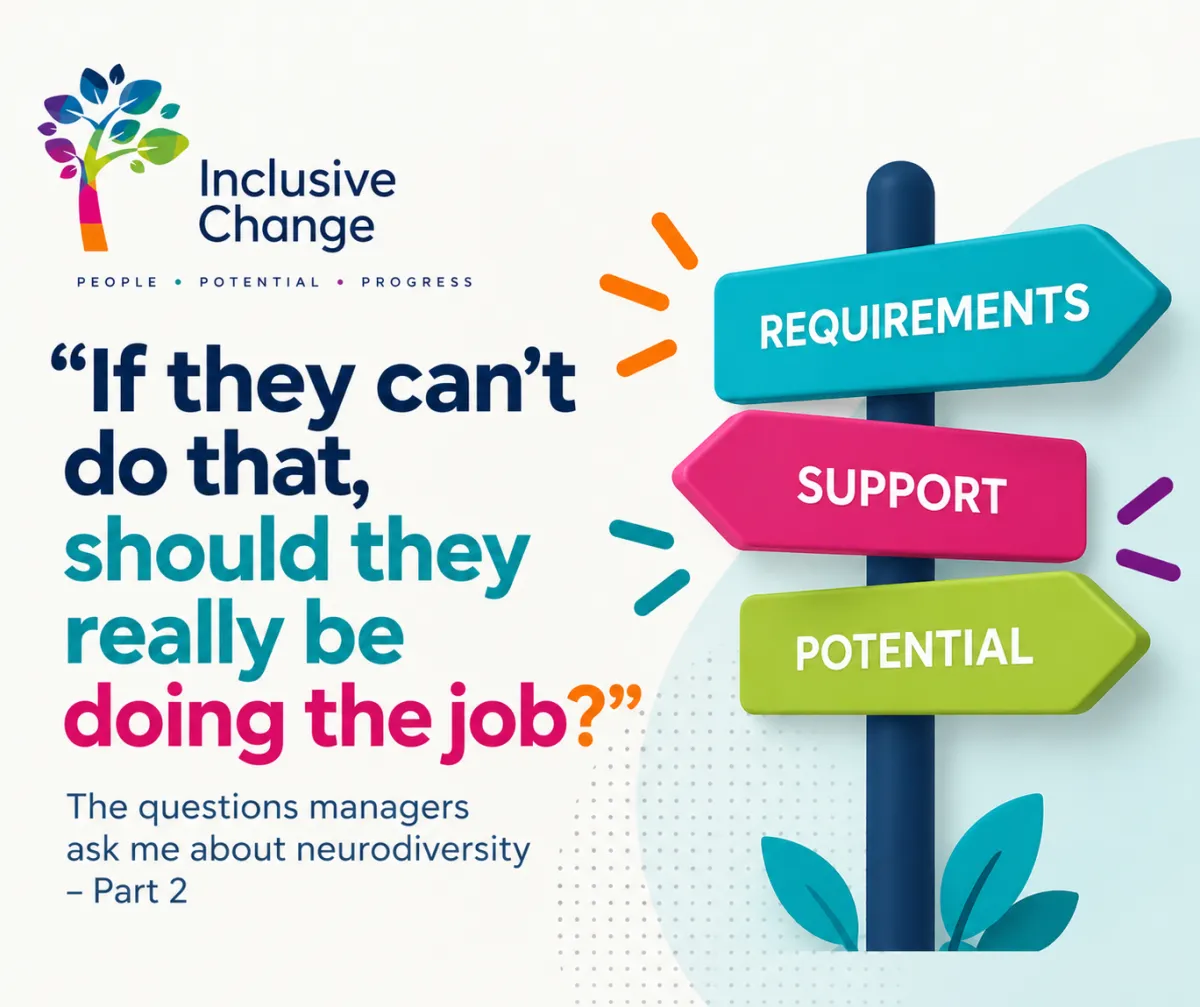
If they can’t do that, should they really be doing the job?
"If they can’t do that, should they really be doing the job?”
The questions managers ask me about neurodiversity – Part 2
There are some questions in neurodiversity training that people ask cautiously. You can almost hear the concern behind them: Am I actually allowed to say this?
One of those questions is:
“If someone can’t do an important part of the job because they’re neurodivergent, should they really be doing that job?”
It’s uncomfortable, but it isn’t a question I want managers to be frightened of asking.
There are genuine requirements in every job. In some workplaces those requirements involve safety, accuracy, speed, communication or making decisions under pressure. Neuroinclusion cannot mean pretending those requirements don’t exist, and reasonable adjustments do not mean that standards simply disappear.
But I think we sometimes jump far too quickly from:
“This person is struggling with part of their job.”
to:
“This person cannot do the job.”
Those are not the same thing.
Before we start questioning someone’s capability, I think we need to separate three things:
The standard we need.
The barrier the person is experiencing.
The way the work is currently organised.
Because sometimes the standard is the problem. But sometimes it’s the route we expect everyone to take to reach it.
What does the job actually require?
In a training session earlier this year we started talking about some of the situations the team was experiencing.
What happens if someone processes information more slowly when the business is busy? What if they need very clear instructions? What if they find it difficult to make judgement calls? What if they struggle to switch between several competing tasks?
These are legitimate questions.
If you are serving customers in a busy restaurant for instance, there are times when speed matters. Orders need to be accurate. Payments need to be processed correctly. Allergen information and safety procedures matter. People need to communicate with colleagues and customers. There will also be occasions when something unexpected happens and somebody needs to make a decision.
It wouldn’t be particularly helpful for me to stand in front of that team and say, “Well, they’re neurodivergent, so you just need to accommodate them.”
Instead, we need to ask a much more precise question:
What does this job actually require this person to be able to do?
That sounds obvious. But once you start examining it, things get interesting.
Does working behind a restaurant require someone to remember five verbal instructions given in quick succession?
Does it require them to understand what a manager means by “just use your judgement”?
Does it require someone to automatically know which of six competing tasks is the priority?
Does being a good team member require someone to understand an instruction that has been hinted at rather than explicitly stated?
Perhaps.
But perhaps not.
Some of those things may be essential requirements of the job. Others may simply be how we have become accustomed to working.
And there is an important difference.
Standards and ways of working are not the same thing
I’ve recently been involved in a neurodiversity summit for the emergency services, and one of the things I found particularly uplifting was hearing real examples of neurodivergent people working successfully in environments where standards really do matter.
One story has stayed with me.
One of our speakers is dyslexic and, when she shared that when she first considered working as an emergency call handler, she worried that her dyslexia would mean she wouldn’t be able to accurately match addresses.
In that role, accuracy clearly isn’t something we can simply decide doesn’t matter. Getting an address right in an emergency is important.
She achieved 98% accuracy.
Later, when her work changed and she needed to produce longer written reports, she found that aspect of the role much more difficult.
This example stayed with me because it demonstrates why broad assumptions about capability can be so misleading.
She wasn’t simply “good at work” or “bad at work”, and dyslexia didn’t make her incapable of performing a demanding role. Different tasks placed different demands on her, and those demands interacted with her dyslexia differently.
That is where support and reasonable adjustments become important.
The standard doesn’t necessarily have to move. Sometimes we need to change the route someone takes to reach it.
“They need everything explaining to them”
Clear instructions are a good example.
I sometimes hear frustration that a neurodivergent employee needs things explained very clearly. There can be a sense that, by a certain point in someone’s career, they should “just know” what is expected.
But I think we need to dig a bit deeper on that.
If an employee is constantly asking their manager to make every decision for them, that might genuinely be an issue in a role requiring independent judgement.
If, however, they are repeatedly asking questions because the manager’s instructions are ambiguous, we have a different problem.
Imagine I tell someone:
“Can you sort the bar out before it gets busy?”
I might think I’ve given an instruction.
But what have I actually asked them to do?
Restock the fridges? Clear glasses? Check bookings? Wipe surfaces? Refill ice? Count the till? All of those things? Which comes first? And what does “before it gets busy” actually mean?
Someone who is good at interpreting context might look around, infer what I mean and get on with it.
Someone who processes language more literally, struggles with prioritisation or finds ambiguity difficult might need to ask.
If I then conclude that they are less competent because they needed clarification, I may be measuring their ability to interpret me, rather than their ability to do their job.
That doesn’t mean they can never be expected to develop independence.
It means we need to be clear about what independence actually means.
What about speed?
This is another difficult one, particularly in hospitality, retail, emergency services and other environments where there are genuine time pressures.
If someone says, “I can’t work quickly because I have ADHD,” a manager cannot simply conclude that speed no longer matters.
But nor should they immediately conclude that the person is incapable of doing the job.
We need to understand what “I can’t work quickly” actually means.
Perhaps they work perfectly quickly when completing one task but slow down dramatically when interrupted. Perhaps they lose time because they cannot identify which task has priority. Perhaps multiple verbal instructions overload their working memory. Perhaps sensory overload significantly affects their processing. Perhaps anxiety about making mistakes means they repeatedly check their work.
Or perhaps, even with appropriate support and adjustments, they genuinely cannot work at the speed an essential part of the job requires.
That possibility matters too.
Neuroinclusion doesn’t mean every person can do every job. There will be situations where an essential requirement genuinely cannot be met.
The important thing is that we don’t arrive at that conclusion before we have understood what is actually happening.
“They can’t make judgement calls”
I find this one particularly interesting because “use your judgement” is something we say constantly at work without necessarily explaining what judgement we expect.
Suppose an autistic employee says they find judgement calls difficult. That could sound significant in a customer-facing role.
But what happens if we explore it?
They might say:
“When something happens that isn’t covered by the normal process, I don’t know what I’m authorised to do. There seem to be lots of possible answers and I’m frightened of choosing the wrong one.”
Now we have something we can work with.
Perhaps the manager can make decision boundaries clearer:
These are decisions you can make yourself.
These are situations where you should follow this process.
And these are the situations where I want you to come and get me.
We haven’t removed judgement from the role.
We’ve helped someone understand the boundaries within which they are expected to exercise it.
And, interestingly, that clarity may improve decision-making for everybody.
Support doesn’t automatically mean dependence
This issue comes up in professional training too.
What if someone is training for a role where there can understandably be an expectation that, as someone progresses, they should demonstrate increasing independence. Emergency services or teaching for instance.
There are, of course, essential aspects of their role that they would need to be able to carry out and take professional responsibility for.
But we need to be careful about equating independence with the absence of support.
A teacher using a checklist isn’t necessarily less independent.
A trainee who receives instructions in writing isn’t necessarily less competent.
Someone using assistive technology hasn’t handed over their professional judgement to a computer.
An employee using an agreed structure for prioritising work isn’t necessarily asking somebody else to do the work for them.
The useful question is:
Who retains responsibility for doing the task, applying the professional knowledge and making the decision?
Support can enable independence rather than undermine it.
Reasonable adjustments aren’t about pretending someone can do something they can’t
There is a legal context to this.
Under the Equality Act 2010, employers have a duty to make reasonable adjustments where a disabled person would otherwise be placed at a substantial disadvantage.
Acas also advises employers to discuss adjustments with the person and consider what might remove or reduce the disadvantage.
That doesn’t mean removing every requirement someone finds difficult, and it doesn’t mean employers can never address performance or capability.
It means we need to think properly about whether disability is creating a barrier and whether there are reasonable ways of reducing it.
For managers, that brings us back to those three things:
1. What is the standard we actually need?
2. What barrier is the person experiencing?
3. Is the difficulty with the requirement itself, or with the way the work is currently organised?
If accuracy is essential, keep the accuracy standard.
If respectful communication is essential, keep that expectation.
If somebody genuinely needs to make certain decisions independently, be clear about which decisions those are.
If customers need to be served within a particular timeframe, understand what that requirement actually is.
Then ask what could reasonably change around the task to help the person meet that standard.
Before questioning capability, ask these questions
When a neurodivergent employee is struggling with part of their role, managers might find it useful to ask:
What is the essential standard or outcome we need?
What specifically is the person finding difficult?
When does the difficulty occur, and what makes it better or worse?
Is the barrier created by the task itself or by the way we currently organise or communicate the work?
Could a reasonable adjustment, clearer process, assistive technology or different way of working reduce that barrier?
With appropriate support in place, can the person meet the required standard?
Those questions give us much more useful information than simply asking whether somebody is capable.
Perhaps we need to turn the question around
So, when someone asks me:
“If they can’t do that, should they really be doing the job?”
I don’t think we have enough information yet.
What exactly can’t they do? What happens when they try? Is the difficulty consistent or does it happen under particular conditions? What is the actual requirement of the job? Why does that requirement exist? What support or adjustment could reduce the barrier? And, with that support in place, can they meet the required standard?
Only then are we having a meaningful conversation about capability.
Because there is an enormous difference between:
“This person cannot meet the required standard.”
and:
“This person cannot meet the required standard in the particular way we have currently designed the work.”
Sometimes, after exploring adjustments and support, we may discover that somebody genuinely cannot perform an essential part of a particular role. Inclusion doesn’t require us to pretend otherwise.
But sometimes we discover something completely different:
The person was capable all along.
The standard didn’t need lowering. The barrier needed removing.
If your managers are navigating questions around performance, reasonable adjustments and neurodiversity, these are exactly the conversations we explore in our workplace training.
At Inclusive Change, we help managers move beyond awareness and develop the confidence to have practical, balanced conversations about barriers, expectations, performance and reasonable adjustments — while still recognising the needs of the individual, the team and the organisation.
This is the second article in my series, The questions managers ask me about neurodiversity, where I’m exploring some of the difficult questions I hear in real workplaces and training rooms.*
Next: “But what about everyone else?” What happens when one person’s reasonable adjustment affects the whole team?