Generational Diversity at Work: Recruiting and Retaining Talent
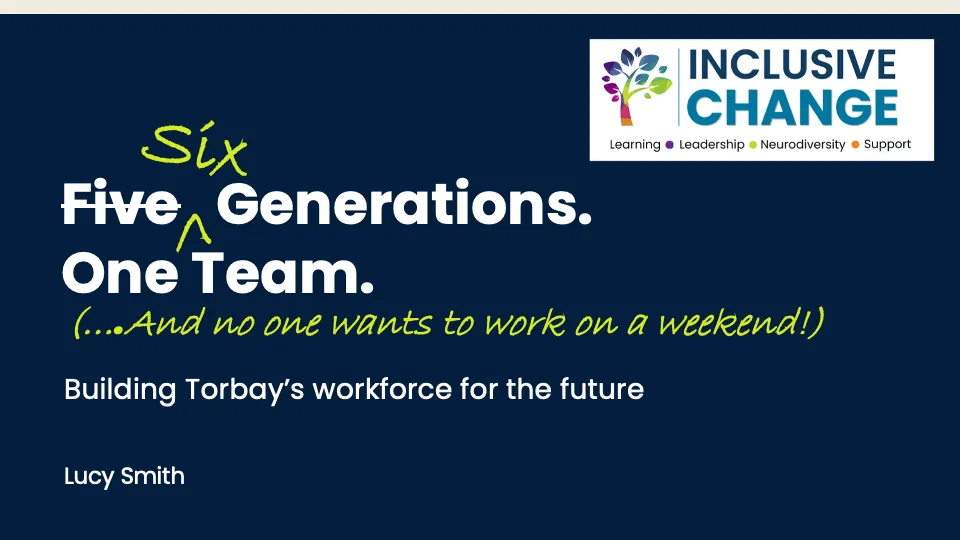
Five Generations. One Team. Has the workplace kept up?
We talk a lot about generational differences at work. But how much of what we’re seeing is actually the workplace changing around people?
When I recently spoke to a group of employers in Torbay, I asked them to remember how they found jobs before online recruitment became part of everyday life.
The local newspaper. A recruitment agency. Dropping a CV at reception. Knowing someone who knew someone.
There were plenty of nods. There were also memories of shared office computers, handwritten letters sent to typing pools and the distinctive noise of loading a computer programme from a cassette tape.
It was a useful reminder of just how much change people have experienced during their working lives. Yet when colleagues approach work differently, we can be surprisingly quick to explain it through their generation.
The workplace has changed around all of us
Think about the difference between starting work in 1990 and starting work today.
Recruitment can involve online forms, competency questions, assessments and automated screening. Candidates can use AI to write applications, while employers may use it to help review them. Once employed, people might work across different locations, communicate through several platforms and receive messages long after the working day has finished.
The tools have changed, but so have expectations about availability, flexibility, careers and progression. People are trying to understand those expectations while managing everything else happening in their lives.
Someone entering their first job is learning workplace systems and unwritten rules. Someone returning after a career break may be discovering that familiar routes into employment have disappeared. Someone with decades of experience may be adapting to another new platform while supporting children and ageing parents.
Generation can help us explore that context. It cannot tell us everything about the person.
We have already written people’s stories
“Entitled.” “Lazy.” “Resistant to change.” “Not resilient enough.”
We hear these descriptions in headlines, conversations and social media posts. Sometimes they arrive disguised as a joke. Repeated often enough, they can start to shape what we expect from people before we have worked with them.
During the talk, an audience member challenged the focus on generations. Their point was that a shared purpose and clear objectives could bring people together across ages. It was a useful challenge, because generational labels can distract us from questions we actually need to ask.
Does this person understand what is expected? Have they had the opportunity to learn? Are they balancing responsibilities we cannot see? Is there a communication difference, an inaccessible process or an assumption getting in the way?
Age, life stage, experience, disability, neurodivergence, caring responsibilities and financial circumstances can all affect someone’s experience of work. Two colleagues born in the same year may need very different things from their manager.
Different experiences can be useful, and sometimes difficult
When I ran Your Village Shop, we worked with people from teenagers on work experience through to volunteers in their eighties.
That brought different knowledge, perspectives and connections into the same workplace. It also brought challenges. People had different expectations about communication, how tasks should be done and what other people ought to know already.
Having different generations together did not automatically make everything work beautifully. We still needed conversations, clear expectations and a willingness to learn from one another.
That learning can travel in both directions. An experienced colleague may understand a customer, a process or the history behind a decision. A newer colleague may ask a question that reveals something everyone else has stopped noticing.
The value comes from making room for both.
Would your best employee get hired today?
This is the question I left employers with.
Imagine that someone who has become invaluable to your organisation had to apply through your current recruitment process. Would they get through? Would the application form reveal their ability? Would the assessment let them demonstrate it? Would they recognise themselves in the job description?
Over the summer, I tried applying for jobs myself. I wanted to understand the experience, and I heard nothing back from the applications I made. It left me thinking about the distance between having something useful to offer and being able to demonstrate it through a recruitment process.
That matters for young people looking for their first chance, experienced people changing direction, and disabled or neurodivergent applicants encountering barriers.
It is worth examining what each recruitment step tells you about someone’s ability to do the job. Some steps may provide useful evidence. Others may mostly show how well someone navigates your process.
You can use this checklist to review your recruitment and retention practices.
Finding people is only part of the challenge
When I asked the audience where they might be losing good people, retention stood out in the responses.
That felt significant. Businesses can put considerable effort into finding talent, then lose people whose circumstances change or whose support needs have never been discussed.
I have left jobs I loved because I could not see how to combine employment with supporting my family. I still cared about the work and wanted to contribute. What I could not see was a workable way to continue.
Employers cannot solve every difficulty in someone’s life. But a conversation about working arrangements, expectations or support may reveal options that neither side has considered.
Before deciding that someone is disengaged, difficult or no longer committed, it is worth asking what has changed.
Five things managers can take away
1. Recruit for the skills you actually need.
Review the requirements and assessments you use. Be clear about what is essential, what can be learned and how applicants can demonstrate their ability.
2. Make working expectations explicit.
Explain communication preferences, deadlines, availability and what good work looks like. People should not have to guess the unwritten rules.
3. Ask what helps.
Create opportunities to discuss support and reasonable adjustments, including during recruitment. Avoid assuming that someone’s age or diagnosis tells you what they need.
4. Share experience in both directions.
Give colleagues opportunities to exchange knowledge, ask questions and challenge familiar approaches. Everyone can have something to teach and something to learn.
5. Manage the person, not the generation.
Use generational context to start a conversation, then get to know the individual in front of you.
Has your workplace kept up?
For employers building their workforce for the future, attracting people matters. So does helping them see a future with you.
That means making opportunities visible, recognising skills across different backgrounds and giving people practical reasons to stay. It also means being willing to examine processes and expectations that may once have worked well but now create unnecessary barriers.
We have adapted to enormous changes in technology and working life. We can keep adapting how we recruit, support and lead people too.
I’m Lucy Smith, founder of Inclusive Change. I work with organisations through leadership development, neurodiversity training, change management and facilitated team workshops. If this has raised questions about your own workplace, let’s start a conversation.
You can also explore your recruitment and retention practices with the free
Employer Checklist: Would your best employee get hired today?.