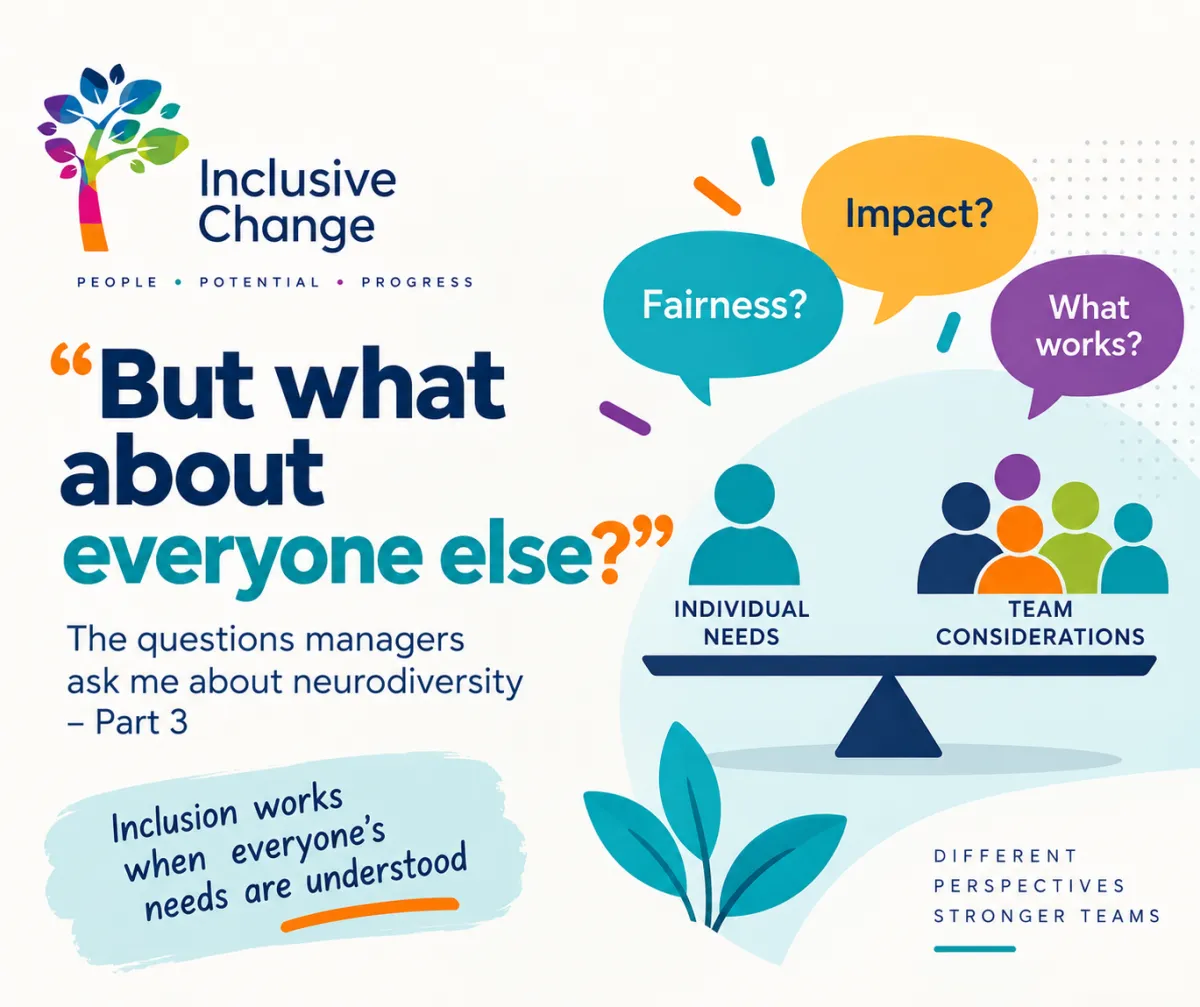
But What About Everyone Else? Reasonable Adjustments and the Wider Team
The questions managers ask me about neurodiversity – Part 3
There is another question that comes up regularly when I’m talking to managers about neurodiversity and reasonable adjustments: “But what about everyone else?”
What happens when an adjustment for one person affects the rest of the team? What if colleagues have to change how they work, someone else ends up picking up more tasks, or the adjustment one person needs makes things harder for somebody else? These are questions I think we need to be much more comfortable discussing.
Sometimes our response to them has been too simplistic. We tell managers that reasonable adjustments are important, that everyone is different and that inclusive workplaces need to adapt. All of that is true, but the manager may still be standing there thinking, “Yes, but I have eight other people in this team and I need this to work for them too.”
I think that’s a legitimate management concern. The problem comes when “what about everyone else?” becomes the reason we stop exploring what a disabled employee needs before we’ve even understood the barrier.
Inclusion doesn’t mean one person’s needs automatically override everyone else’s
If someone is disabled, their employer may have a legal duty to make reasonable adjustments. That duty matters and shouldn’t disappear simply because making a change requires some effort or because colleagues would prefer everything to stay as it is. At the same time, reasonable adjustment doesn’t mean that every solution somebody suggests must automatically be implemented exactly as requested, regardless of its impact.
The Equality Act 2010 requires employers to take reasonable steps to avoid a disabled employee being placed at a substantial disadvantage, and what is reasonable will depend on the circumstances. UK Government guidance on reasonable adjustments for disabled workers Acas recommends discussing potential adjustments with the employee and, where a particular adjustment isn’t considered reasonable, explaining that and looking for another way to support them. Acas guidance on reasonable adjustments
That process of exploring is important because the need and the proposed solution aren’t necessarily the same thing.
Imagine an employee says they need colleagues to stop eating at their desks because they find food smells overwhelming. The manager might immediately start thinking about everyone else. Perhaps people work different shifts, there isn’t a particularly good staff room, some employees need to eat at particular times and people have been eating at their desks for years. From the manager’s perspective, changing the rule for everyone because one person struggles with smells might initially seem unreasonable.
But we’re already discussing the solution before we’ve properly understood the problem.
A better conversation starts with, “Can you help me understand what happens for you?” Perhaps certain smells make concentrating almost impossible. Perhaps they become nauseous, experience sensory overload or have to leave the room. Perhaps it is only particular foods or particular times of day. Once we understand the actual barrier and its impact, we can start exploring options.
Stopping everyone from eating at their desk might be one option, but perhaps there are others. Different seating, a designated eating space, ventilation, changes to break arrangements or something we haven’t thought of yet might achieve the same thing with less impact on colleagues. I don’t know which answer is right in that hypothetical situation because I don’t have enough information – and that’s precisely the point. Managers don’t always need to know the answer immediately. They need to know how to explore the problem.
Sometimes the adjustment should change things for everyone
There are also times when somebody tells me that the whole team will have to change because of one person’s adjustment and I find myself wondering whether the proposed change is actually something we should have been doing anyway.
Clear expectations are a great example. An autistic employee might need their manager to be explicit about priorities, deadlines and what a completed task should look like. The manager can experience this as having to communicate differently for one person, but perhaps we should ask why those things aren’t clear for everybody.
If an adjustment means replacing “Can you sort that out when you get a chance?” with “Please complete this by 3pm today; these are the three things I need included, and if this happens, come back to me,” I’m not particularly concerned that we’ve accidentally made things clearer for the rest of the team too.
The same might be true of providing agendas before meetings, following up important verbal conversations in writing, clarifying responsibilities, giving people predictable feedback or explaining the reasons for changes rather than simply announcing them. This is where the phrase “good for everyone, essential for some” can be really useful. Some adjustments expose things we could probably be doing better as managers anyway.
However, “good for everyone” doesn’t mean that every adjustment should automatically become a universal workplace practice. Sometimes an individual needs something quite specific, and sometimes that really does have consequences for other people.
Sometimes there really is an impact on the team
This is the part I think we need to acknowledge more openly. Supporting one person can change somebody else’s working experience, and occasionally it can change their workload too.
Imagine someone who finds rapid task-switching particularly difficult. The team reorganises work so that this employee has longer periods focusing on one thing rather than constantly responding to interruptions. That might be an effective adjustment for them. But if the unintended consequence is that another employee now handles every interruption, every unexpected customer and every urgent task, we haven’t necessarily created a sustainable solution. We may simply have moved the pressure from one person to another.
The same problem can occur when colleagues are repeatedly expected to compensate informally for tasks somebody else isn’t completing. Resentment can build, particularly because managers also have to respect the disabled employee’s privacy and can’t necessarily explain why work is being organised differently.
Acknowledging this doesn’t make somebody anti-inclusion. It means the manager needs to look at the whole system rather than treating an adjustment as something that exists only between them and one employee. We can protect someone’s confidentiality while still examining whether the way the work has been organised is sustainable.
The important thing is not to turn that impact into blame. Telling somebody, “Everyone else is having to pick up your work because of your adjustment,” isn’t likely to lead to a particularly constructive conversation. Instead, the manager needs to understand which tasks aren’t being completed, why that is happening, whether the adjustment itself is causing the problem or whether another barrier remains, and whether work could be organised differently.
Sometimes what looks like a problem with the adjustment is actually a poorly designed adjustment.
What if two people’s needs conflict?
This is perhaps the clearest example of why inclusion can’t simply mean accommodating one person without considering anybody else.
One employee may need quiet to concentrate while another regulates themselves through movement or talking. One person may need a high degree of predictability while another works much better with flexibility. An employee with sensory sensitivity may need lower lighting while somebody with a visual impairment may need a brighter environment.
It is tempting to ask whose need wins, but I don’t think that’s a particularly useful starting point. Neither person’s need becomes less legitimate because somebody else needs something different.
Instead, we need to understand both barriers. Is there a way of changing the physical environment, working pattern or process that reduces the disadvantage for both people? Could people work in different areas? Could there be quiet and collaborative spaces? Could lighting be individually controlled? Could working patterns be changed?
Sometimes there will be a straightforward answer. Sometimes there won’t be, and occasionally there will be genuinely difficult decisions to make. Inclusion isn’t about pretending competing needs don’t exist. It’s about having a decent process for working through them.
Fair doesn’t always mean everybody gets the same thing
There is another issue sitting underneath “What about everyone else?” and that’s fairness.
Why does she get to work from home? Why does he get written instructions? Why doesn’t she have to do that particular task? Why does he get more time? Why are the rest of us being asked to change because one person needs something different?
Managers need to be able to navigate those conversations without disclosing somebody else’s personal information. Fairness at work doesn’t necessarily mean everybody receives exactly the same thing. Sometimes people need different things in order to have a fair opportunity to succeed.
But I also don’t think “fair doesn’t mean equal” should become a phrase we use to shut colleagues down. If somebody’s workload has genuinely increased, their working environment has become difficult or their own needs aren’t being met, telling them that fairness isn’t equality doesn’t solve the problem. We still need to listen to what is happening for them.
This is why I increasingly think about adjustments through three different lenses: the individual, the team and the job.
The individual needs to be able to access work without being substantially disadvantaged because of disability. The team needs a working environment that is sustainable and respectful, recognising that other team members may have disabilities, needs and pressures of their own. At the same time, the actual work still needs to be delivered.
Good management is about holding those things together rather than pretending one of them doesn’t matter.
Reasonable adjustment is a process, not a magic answer
I think this is the message I most want managers to hear. You don’t have to receive a request for an adjustment and immediately know whether it’s reasonable. The employee doesn’t necessarily have to arrive with the perfect solution either.
We can start by understanding the barrier and its impact. Then we can look at what the person is trying to be able to do, what the job genuinely requires and what options might reduce the disadvantage. We can consider the implications of those options, including the impact on other people, agree something to try and then review whether it actually works.
Sometimes we’ll discover a very simple change that benefits everybody. Sometimes we’ll need a highly individual adjustment. Sometimes we’ll need occupational health, Access to Work or other specialist advice. Sometimes we’ll try something and discover that it doesn’t work as expected, and we’ll need to try something else.
That isn’t failure. It’s what good adjustment conversations should look like.
So when a manager asks me “But what about everyone else?”, I don’t want to tell them that’s the wrong question. I want to help them ask some additional ones.
What is the impact on this individual? What is happening for the rest of the team? What does the job actually require? What are the barriers we’re trying to remove? What options haven’t we considered yet, and how will we know whether what we try is working?
Because supporting a disabled employee and managing the needs of the wider team aren’t competing responsibilities.
They are both part of being a good manager.
This is the third article in my series, The questions managers ask me about neurodiversity, where I’m exploring some of the difficult questions I hear in real workplaces and training rooms. These aren’t questions I want managers to be frightened to ask. They’re questions I think we need to get much better at answering.
Next: “I can’t do that because I have ADHD.” What should a manager say next?