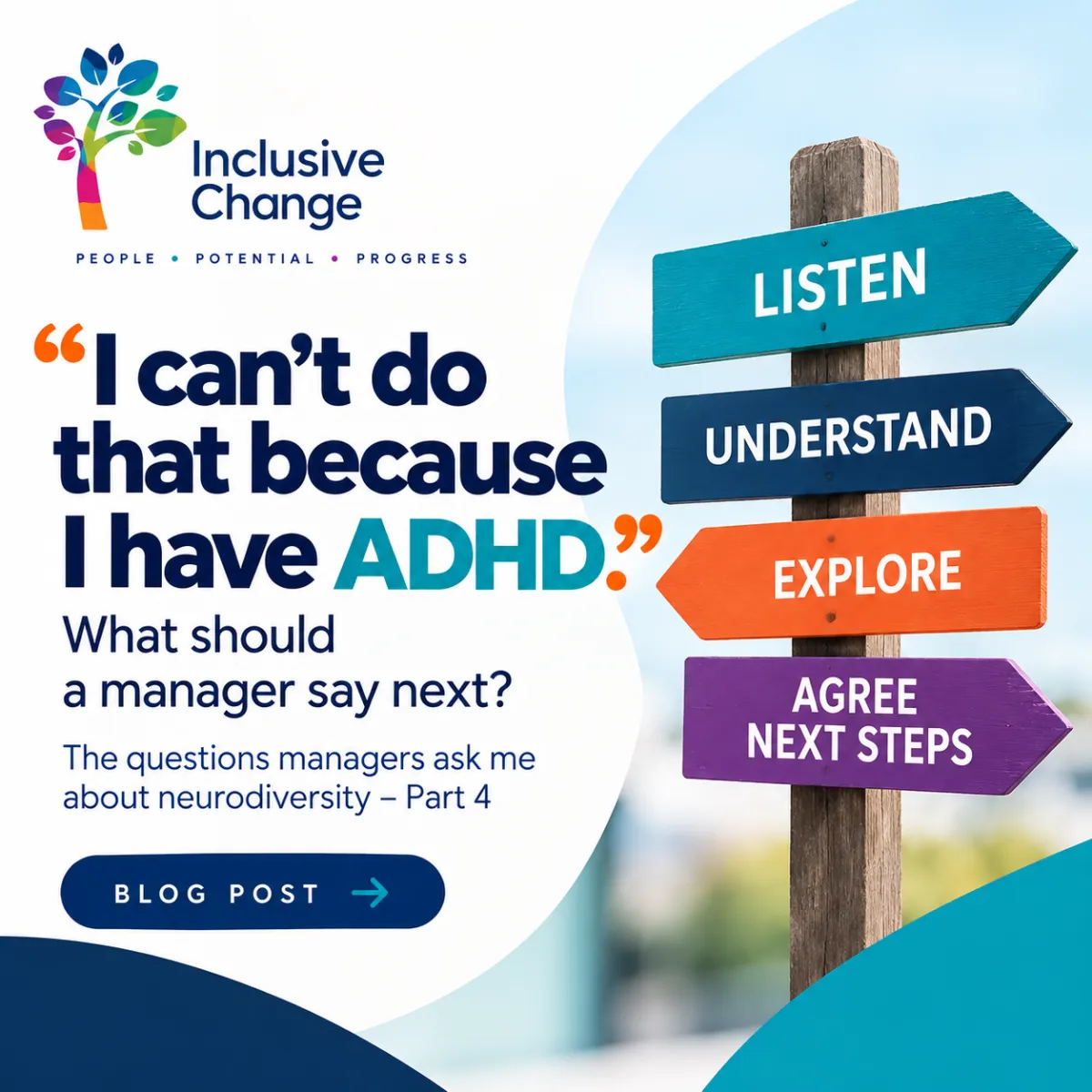
“I can’t do that because I have ADHD.” What should a manager say next?"
“I can’t do that because I have ADHD.” What should a manager say next?2
The questions managers ask me about neurodiversity – Part 4
There is a moment I see quite often when I’m talking to managers about neurodiversity and reasonable adjustments. An employee says something like, “I can’t do that because I have ADHD,” and the manager freezes.
They may be thinking, Right. ADHD is a disability. I don’t want to discriminate. Am I allowed to question this? Can I still expect them to do the task? What if it’s an essential part of their job? What am I actually allowed to say now?
I understand that nervousness. Managers are increasingly aware that they need to take disability seriously, but awareness without confidence can sometimes leave people frightened to have perfectly legitimate management conversations. They either back away completely because they don’t want to say the wrong thing, or they become frustrated and jump to the opposite conclusion: “Well, if you can’t do it, perhaps you shouldn’t be doing this job.”
Neither response tells us very much about what is actually happening.
I think we need to help managers understand that when someone says, “I can’t do that because I have ADHD,” the conversation doesn’t have to end there. In many cases, that’s exactly where the useful conversation begins.
You don’t need to challenge the ADHD
The first thing I want managers to understand is that you don’t need to decide whether someone’s ADHD really causes the difficulty they’re describing. You’re not there to diagnose them, test their disability or decide whether you would experience the same problem.
What you need to understand is the impact at work.
There is a big difference between asking, “Why can’t you do it?” in a way that sounds like a challenge and saying, “Okay. Can you help me understand what happens for you when you try to do it?”
That small change in language can completely change the conversation.
Suppose an employee says, “I can’t deal with all these last-minute changes because of my ADHD.” Rather than immediately deciding that the workplace must stop making changes, or telling them that change is simply part of the job, we can get curious about what they mean.
Which part of the change is difficult? Is it switching away from something they’ve already started? Is it remembering the new instructions? Is it having to reprioritise several competing tasks? Does an unexpected change create so much cognitive load that they lose track of what they were doing? Does it take them longer to process the new information?
Those answers matter because they lead to very different possible solutions.
“I can’t” can mean lots of different things
I think this is something we sometimes miss in workplace conversations. When someone says “I can’t do that,” we tend to hear it as a statement of absolute capability.
But “I can’t” might mean I can’t do this reliably in the way we’re currently doing it. It might mean I can do it, but it takes me three times as long. It might mean I can do it in a quiet environment but not while being interrupted. It might mean I can do it if I know which thing takes priority. It might even mean I can do it, but the effort required to do it this way is becoming unsustainable.
Of course, it can also genuinely mean, I cannot do this task.
The manager doesn’t know which of those they’re dealing with until they have the conversation.
This is why I don’t think the best response is simply, “What adjustment do you need?” That sounds inclusive, but it’s actually quite a big question. We’re asking someone to identify what’s happening internally, understand which aspect of their neurodivergence is relevant, analyse the workplace barrier, generate possible solutions and predict which one will work.
They may have absolutely no idea.
Start with what actually happens
Imagine a busy hospitality environment. An employee says, “I can’t work quickly because I have ADHD.”
Speed may genuinely matter in that workplace. Customers need serving, orders need to be accurate and colleagues need to be able to rely on one another during busy periods. The manager can’t simply say, “Okay, you don’t need to work quickly anymore.”
But “you need to work faster” isn’t particularly useful either.
I would want to know what happens when the pace increases. Perhaps the employee is perfectly quick when working through one stream of orders, but their performance drops when three people give them instructions at the same time. Perhaps they lose their place when interrupted and have to start again. Maybe they struggle to decide which of several competing demands is most urgent, or perhaps they repeatedly check their work because they’re worried about making mistakes.
Once we understand that, we have something much more useful than “ADHD means I can’t work quickly.”
Perhaps the team can agree clearer priorities. Maybe instructions need to come through one person during particularly busy periods. Perhaps there is a checklist, a visual system or a clearer division of roles that reduces unnecessary switching. Maybe there is a quieter task that can be allocated during a particularly intense part of the shift without fundamentally changing the person’s role.
Or perhaps, after exploring the barriers and reasonable options, there remains a genuine difficulty meeting an essential requirement of the role. We need to be able to acknowledge that possibility too.
The point is that we shouldn’t decide which of those situations we’re dealing with before we’ve done the work to understand it.
“I can’t make judgement calls”
This is another example that has come up in training.
Imagine someone says, “I’m autistic. I can’t make judgement calls.” If their job genuinely requires independent decision-making, that could sound like a fairly fundamental problem.
But again, I want to know what they mean.
Perhaps what they’re actually saying is, “When something happens that isn’t covered by the normal process, I don’t know what I’m authorised to decide. I can see several possible answers and I’m frightened of choosing the wrong one.”
Now we have a very different problem.
The manager might be able to make the decision boundaries clearer: these are the things I expect you to decide yourself, these are situations where you should follow this process, and these are the things I want you to escalate to me.
We haven’t removed judgement from the job. We’ve made explicit something that other employees may have learned through observation, implication or experience.
And this is where I think managers sometimes accidentally assess neurodivergent people on their ability to infer the unwritten rules of the workplace, rather than on their ability to perform the job.
What if they genuinely don’t know what would help?
This is incredibly common, particularly for people who are newly diagnosed or only beginning to understand their neurodivergence.
We often tell managers, “Ask the person. They’re the expert in themselves.” There is truth in that, but I think we’ve oversimplified it.
Someone may be the expert in what it feels like to be them and still have absolutely no idea what workplace adjustment would help.
They might know that they’re exhausted at the end of every shift but not understand why. They might know they repeatedly get into difficulty when plans change but not recognise what happens to their processing at that point. They may have spent years masking, compensating or simply assuming that everybody finds work this difficult.
So when the manager asks, “What would support you?”, the answer may genuinely be:
“I don’t know.”
Or perhaps:
“Nothing. I’m fine.”
The manager doesn’t need to respond, “Well, you’re clearly not fine.” They can talk about what they have actually observed.
“Okay. You don’t need to come up with an adjustment now. I have noticed that you’re regularly staying an hour later than everyone else to finish the paperwork. Could we look at what’s happening with that particular task?”
That’s a much easier conversation than asking someone to design their own reasonable-adjustment plan from scratch.
Surely their diagnostic report tells us what they need?
This question came up recently too, and I can understand why managers ask it. If somebody has been diagnosed with autism, ADHD or dyslexia, surely there must be a report somewhere that tells us what support they need?
Sometimes a diagnostic report contains useful information. But a diagnostic assessment is primarily answering a diagnostic question. It isn’t necessarily a workplace needs assessment for this particular job, with this manager, in this environment, at this point in the person’s life.
The report may also be years old. Somebody diagnosed during school might have pages of information about their experience in education but very little that tells a manager what happens when they’re serving customers on a busy Saturday night, teaching a class, writing a complex report or dealing with three competing priorities.
Even a recent report might tell us that somebody experiences executive-function difficulties. That’s useful information, but what does it mean here? Do they struggle to initiate tasks, switch between them, remember verbal instructions, prioritise competing demands or estimate how long something will take?
Those are workplace conversations.
I also wouldn’t want managers to leave neurodiversity training thinking that the solution is to ask employees to hand over their diagnostic reports. We don’t need someone’s entire medical or developmental history to start talking about what’s happening at work.
A diagnostic report can tell us something about a person’s neurodivergence. It can’t tell us everything about what it’s like to be that person doing this job, in this workplace, with this team, today.
You are allowed to ask questions
There is a legal context here, and perhaps ironically I think understanding it can help managers feel less frightened.
Under the Equality Act 2010, employers have a duty to make reasonable adjustments where a disabled person is placed at a substantial disadvantage. UK Government guidance on reasonable adjustments for disabled workers Acas recommends talking with the person about what adjustments might help and keeping adjustments under review because circumstances and needs can change. Acas guidance on reasonable adjustments
Having that conversation isn’t discrimination. Done appropriately, it is part of understanding whether there is a disability-related barrier and what might reasonably be done about it.
Managers need to be thoughtful about what they ask and why. There is a difference between exploring how somebody’s disability affects their work and interrogating them about their diagnosis or private medical history. But fear of saying the wrong thing shouldn’t result in managers saying nothing at all.
If someone tells you they’re struggling, you can ask them to help you understand what happens. You can talk about the requirements of the job. You can discuss what you’ve observed. You can explore different ways of working. You can agree something to try and review whether it works.
In fact, those conversations are often exactly what good management requires.
The diagnosis isn’t the end of the conversation
Perhaps this is the shift I want managers to make.
When an employee says, “I can’t do that because I have ADHD,” don’t immediately hear either “I no longer have to do this” or “I’m incapable of doing my job.”
Hear:
“There may be a barrier here that we need to understand.”
Then explore it. What happens when they try? Which part is difficult? When does it happen? What makes it worse? What helps? What does the job genuinely require? What are we trying to make possible, and what could we reasonably try?
Sometimes the answer will be a straightforward adjustment. Sometimes it will involve clearer expectations or better management. Sometimes specialist advice may help. Sometimes the employee won’t know what they need and you’ll have to work it out together. And occasionally you may discover that there is a genuine capability issue that can’t be resolved simply by changing the way the work is done.
But you won’t know that at the beginning.
That’s why I want managers to feel confident enough to stay in the conversation.
“I can’t do that because I have ADHD” isn’t necessarily the end of a management conversation. It can be the beginning of a much better one.
This is the fourth article in my series, The questions managers ask me about neurodiversity, where I’m exploring the difficult questions I hear in real workplaces and training rooms. These aren’t questions I want managers to be frightened to ask. They’re questions I think we need to get much better at answering.
Next: “They’re rude and they’re upsetting the team. What are we supposed to do?”