Thank you for helping to
Keep the conversation going
Here are some ways we can help you.
We hope you enjoyed The Castle Conference: Digital Wellbeing for Young People.
We know you want to keep the conversation going so we have created a page to help you do that.
The page will be updated with slides and videos when they are available.
Digital Safety Training & Consultancy
Digital Safety can provide a range of training services and consultancy. From one cyber security for non-profits to training for parents in your community.
Inclusive Change Support and Training
Want to know more about neurodiversity in your community? We can help: from unlocking the potential in your teams to deepening awareness of safeguarding vulnerable people.
Watch the Castle Conference Catch Up
We hope that The Castle Conference inspired you, got you thinking and talking about the topic of Digital Wellbeing. We really hope you have been talking about the conference to your friends, family and colleagues.
We certainly are and we arranged it!
The Castle Conference Catch-Up was a chance to keep talking, a chance to share your thoughts, a chance to find out what questions we have been asked since the day and a chance to ask us new questions.
Andy & Lucy
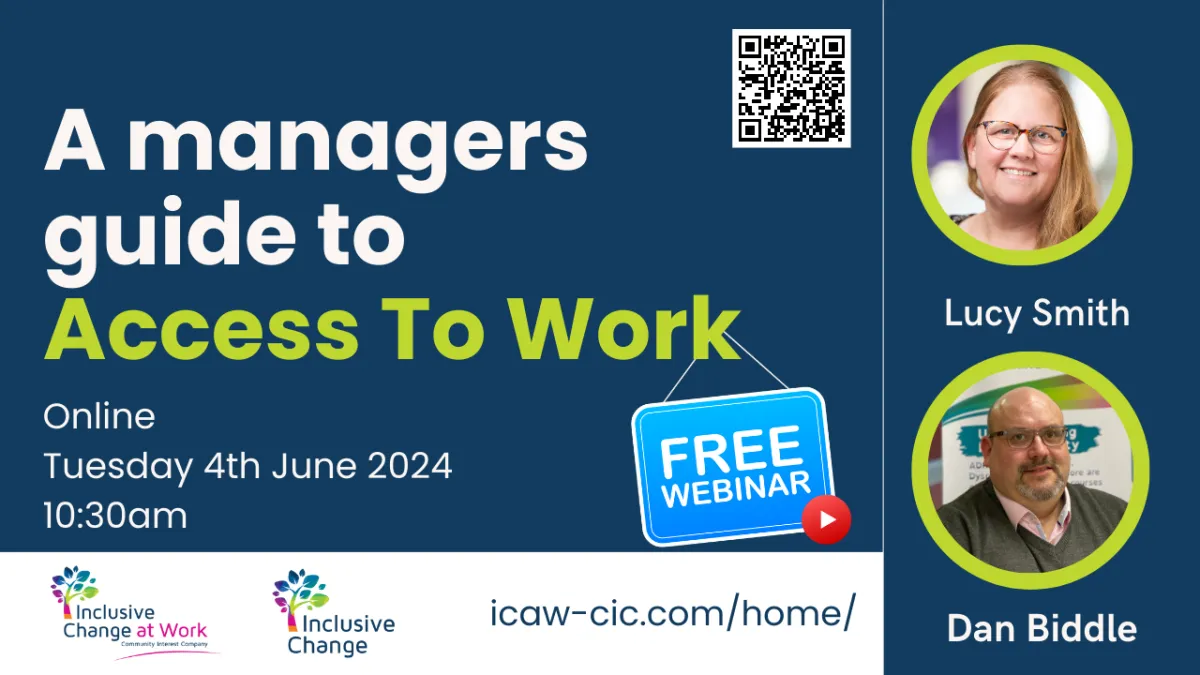
4th June 2024
Free Webinar
Join Lucy & Dan from Inclusive Change At Work CIC who will be discussing how to support disabled and neurodivergent employees to thrive at work.
Recap from the event
We have combined the slides into a video for you to rewatch
This is only the slides - no audio. Videos will be uploaded soon.
Speaker Videos
We will be uploading videos from The Castle Conference as soon as they are available.
COMING SOON!
Resources
Links and downloads for you
Watch or listen online to our podcasts

Spotify Podcast
Listen to our speakers and exhibitors
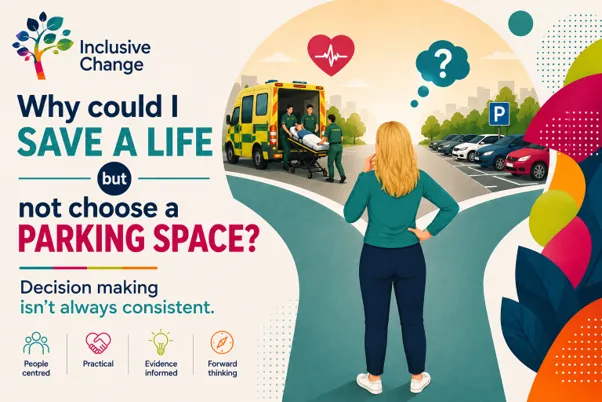
Why Could I Save a Life… But Not Choose a Parking Space?
Why Could I Save a Life… But Not Choose a Parking Space?
There was a period in my life when choosing a parking space felt impossible.
Not because I couldn't drive. Not because the car park was full. Simply because my brain refused to decide.
I'd pull into the station car park, look at the empty bays, and immediately start calculating every possible outcome. Should I park closer to the platform? What if that space was reserved? Would another train arrive before I'd found somewhere? Would I struggle to get out later? Would the other side be better?
I'd drive around. Then around again. Sometimes I'd leave altogether. More than once, I simply drove home because I couldn't make the decision.
That still fascinates me, because for most of my career I made decisions under extraordinary pressure. I worked in environments where uncertainty was normal and where getting something wrong genuinely mattered.
One Saturday morning, driving to deliver a training session for school governors, the car in front of me suddenly veered across the road and hit a tree. No flashing blue lights. No crowd gathering. Just silence.
I stopped, checked the driver, and realised quickly they were having an epileptic seizure. Another car approached. I stepped into the road, stopped it, and told the driver to call 999. They were reluctant - they had a child in the car. It didn't matter. We needed an ambulance.
We kept the casualty safe while the seizure continued. When they came round, confused and distressed, they tried to climb out of the wrecked car before they understood what had happened. We held them safe until the paramedics arrived. Then I got back in my car and carried on to my training session. No drama. No panic. Just the next decision.
For years I couldn't reconcile those two versions of myself: the woman who could calmly manage a roadside emergency, and the woman who couldn't decide where to park. Eventually I understood they weren't contradictory at all. They were happening in completely different environments.
In a crisis, the objective is usually crystal clear - keep someone alive, protect people, get help. The choices in front of you are limited: you can only do so much with what's there. And you find out almost immediately whether what you did worked. There's no time to explore every possible outcome, because the situation itself won't let you. Your focus narrows. The next decision becomes obvious, because there's rarely more than one decision available to you.
Everyday life offers none of that structure. There's rarely one right answer. There are dozens, hundreds, sometimes what feels like thousands, and every option comes trailing its own imagined consequences, most of which will never actually happen and none of which you'll find out about for days, weeks or ever. What if I choose the wrong train? What if I regret this hotel? What if, what if, what if. No urgency to force a decision. No feedback to tell you whether it mattered. Just space, endless space, for the mind to keep running the same calculation without ever reaching an answer.
When I was burnt out, those what-ifs became relentless. Every decision seemed to branch into ten more. The effort wasn't in making the choice - it was in trying to predict every future consequence before I allowed myself to make one. Burnout and anxiety don't just make you tired. They flood your working memory with noise, so that a decision which should take a second gets processed as though it carries the same weight as an emergency, without any of the clarity an emergency actually provides. This is what researchers call decision fatigue - the more choices, real or hypothetical, the brain has to weigh, the less capacity it has left for the next one. Looking back, I wasn't struggling because I lacked intelligence or experience. I was overwhelmed.
Someone recommended Mel Robbins' book The 5 Second Rule. I dismissed it at first - five, four, three, two, one, surely life isn't that simple. But I tried it. Not because I believed counting backwards had some magical power, but because it interrupted the conversation running on a loop inside my own head. Instead of letting another twenty hypothetical outcomes appear, I made a decision. Was it always the right one? No. Did it move me forward? Almost always. The rule doesn't remove anxiety and it was never designed to. What it does is create just enough urgency to stop the rumination before it starts - the same narrowing of focus a crisis gives you for free, manufactured on demand.
That experience changed how I think about leadership.
We celebrate leaders who decide quickly. We criticise people who seem indecisive. But I think we're often asking the wrong question. The issue usually isn't confidence. It's cognitive load.
Every day, organisations ask people to make decisions while navigating uncertainty, constant interruptions, overflowing inboxes, three Teams chats and competing priorities, often during a change programme that's dismantling the certainty they used to rely on. Then we wonder why decisions slow down. We mistake overwhelm for incompetence.
I've watched this happen repeatedly during organisational change. When people lose certainty, they lose clarity. More meetings get scheduled. More options get explored. More documents get produced to cover every angle. Decision-making slows further still, and perversely - everyone ends up working harder while making less progress.
The answer is rarely to tell someone to "be more decisive." It's to ask a different question of ourselves as leaders: are we giving people a clear objective, or are we handing them ambiguity and calling it empowerment? Are we reducing the number of things they need to weigh up, or quietly adding to the pile every time we ask for "one more option to consider"? Sometimes the most useful thing a leader can do is remove choices, not add them - a shared understanding of what success looks like, and permission to stop there.
That's why I've become fascinated by structured decision-making — not because every problem can be solved with a framework, but because a good framework does exactly what a crisis does naturally. It reduces a thousand possible questions down to the handful that actually matter. Over the past few years, that thinking has shaped my own work, through CLEAR and eventually DECID:R - not because I set out to build another model, but because I wanted to understand something I'd lived through myself. Why did I perform so well when the stakes were highest, and struggle so badly when they were almost non-existent?
I don't think I'm unusual. I think a lot of us are carrying brains overloaded by possibility, in roles that keep adding options instead of taking them away.
Perhaps the greatest gift a leader can give isn't a better answer. It's greater clarity - because clarity reduces fear, clarity reduces hesitation, and clarity lets people move. Sometimes that's all a good decision is. Not the perfect choice. Just the next right step.
So here's the question I've been left with. When someone on your team seems indecisive, are they really struggling to decide - or are they quietly trying to process far more possibilities than anyone was ever meant to carry? Maybe the quality of our decisions was never really about intelligence at all. Maybe it was always about clarity.
If this resonated, come and explore it further.
I run DECID:R Live - practical, in-person sessions on structured decision-making for leaders navigating pressure, change and uncertainty. We work through exactly this: how to spot when a team is overwhelmed rather than indecisive, and how to build the kind of clarity that lets people move.
Get Your FREE eBook
A Practical guide to Simplify your Digital Life
Digital Safety CIC - Online Resources
Exhibitor Information
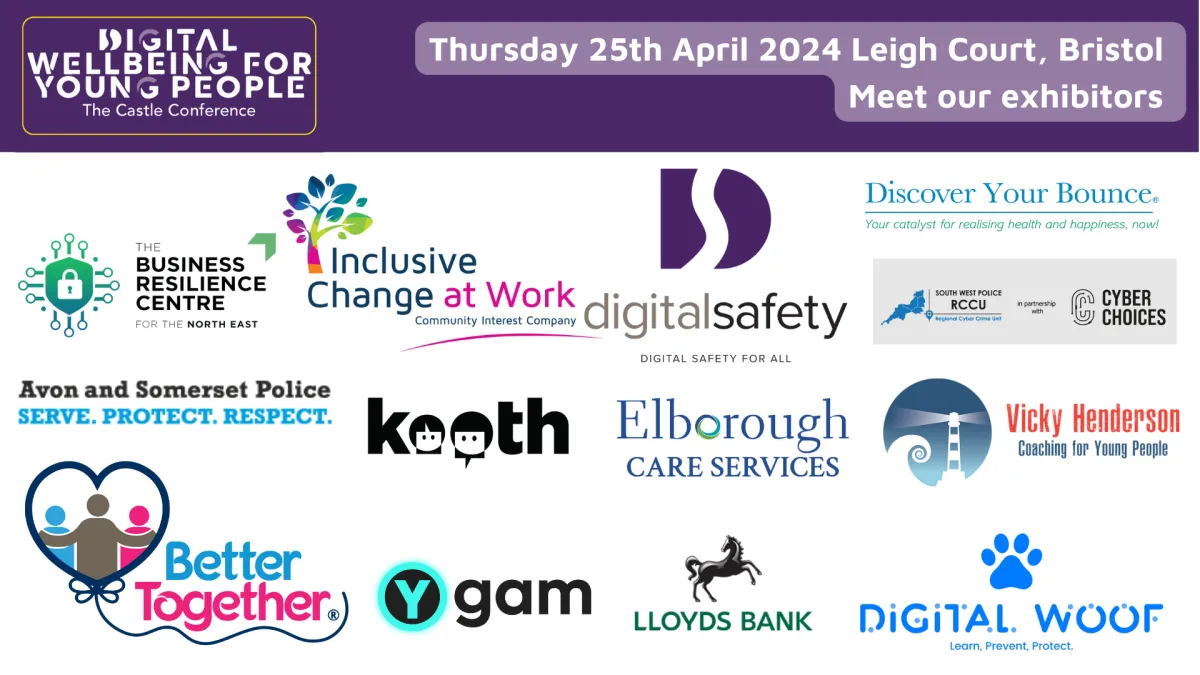
We think you will agree that our exhibitors contributed so much to the event.
We know that we can tackle the problems we face alone - which is why we love working with others.
Thank you - you made the day INCREDIBLE!
Inclusive Change At Work CiC
Bradbury House
Wheatfield Road
Bradley Stoke
Bristol
BS32 9DB
Companies House: 13271923
ICO registration: ZZB293922
UK register of Learning providers
UKRLP: 10090653
Privacy Policy | Terms and Conditions
Copyright © 2024 Inclusive Change At Work CiC | All Rights Reserved
LinkedIn